
The Idea
A country can export more, attract foreign investment and process more of its raw materials without developing the productive capabilities needed to sustain higher productivity or enter more complex activities. Export values and processing volumes are important evidence of economic activity, but they are incomplete measures of structural transformation.
This essay defines transformative trade as trade that causally contributes to durable productive capabilities and expands an economy’s feasible set of future activities. The definition is deliberately stricter than ‘more value added at home’. It asks whether trade supports learning, productive linkages, upgrading and the capacity to diversify. It also requires attention to distribution, fiscal cost, environmental effects and legal feasibility.
The essay advances three claims. First, trade creates opportunities through market size, access to inputs and knowledge, competition and production linkages, but the conversion of these opportunities into capabilities depends on domestic institutions and complementary investment. Second, the African experience exposes a recurring gap between activity at the export frontier and capability across the wider economy. Third, a four-part diagnostic test, value capture, capability formation, linkage and dynamism, can improve the design and evaluation of trade-related policy. It is a practical framework for making the claim of transformation specific, testable and capable of being disproved.
The problem with measuring trade as an outcome
This is a problem of inference. An increase in exports is an observed outcome. Structural transformation is a change in the underlying productive structure. The first may accompany the second, but the relationship is neither necessary nor automatic. A commodity-price increase can raise export earnings without changing production. A processing plant can increase the value of exports while importing most equipment and inputs. A foreign-owned factory can create jobs but maintain limited links to domestic suppliers.
Structural transformation is commonly understood as changes in the sectoral and task composition of an economy, including the movement of labour and other resources towards higher-productivity activities.[1] Yet changes in resource allocation do not necessarily translate into sustained productive development. The gains from reallocation depend partly on whether the activities receiving these resources can improve their productivity and expand the economy’s productive capabilities over time. Research on developing economies shows that structural change can contribute to economic growth, while productivity performance within modern sectors remains a concern.[2] Structural transformation must therefore be understood in terms of both the movement of resources between activities and the upgrading of existing ones. This distinction is particularly important in the African context, where immediate productivity gains from structural change may coexist with a weakening of longer-term productive dynamism, a concern captured by the notion of ‘static gains, dynamic losses’.[3]
Trade is a potential channel of transformation. The analytical error is to treat the channel or its immediate output as proof that transformation has occurred. Trade can influence productive structure through four mechanisms. Each can generate gains, and each can fail.
Market size and scale
Access to regional and global demand can allow firms to specialise, spread fixed costs across more sales and justify investment in machinery, quality control and worker training. This is especially relevant where national markets are too small to support efficient production.[4] Yet market access only creates an opportunity to scale. Whether firms use it to invest, upgrade or build local supply relationships depends on finance, infrastructure, competition and policy credibility.
Inputs, technology and knowledge
Imports can increase productive capacity by giving firms access to machinery, components, software and specialist services unavailable domestically. Imports may be essential to productivity and export competitiveness. The developmental question is whether firms learn to operate, maintain, adapt and eventually supply some of the associated goods and services, where that is economically feasible. Import dependence is therefore not automatically a failure. However, the inability to learn, diversify suppliers or develop complementary capability may be.
Competition and selection
Trade liberalisation exposes domestic firms to competitive pressures that can encourage greater efficiency, improved product quality and innovation. However, competition alone does not guarantee industrial upgrading. Firms with limited access to finance, technology and productive infrastructure may struggle to adjust before they have developed the capabilities needed to compete. The consequences of liberalisation therefore depend on the productive conditions under which competition occurs, the capacity of firms to adapt and the pace at which exposure takes place. Evidence from 131 developing countries between 1991 and 2020 indicates that trade liberalisation reduced manufacturing employment on average, with particularly pronounced effects in sub-Saharan Africa and Latin America.[5] These findings challenge the assumption that opening domestic markets will automatically generate industrial upgrading. The relevant policy question is how trade can expose firms to the benefits of competition while enabling them to develop the capabilities necessary to respond productively to it.
Linkages and learning
Exporting firms can create demand for local suppliers, logistics, maintenance, packaging, professional services and technical training. Buyers can transmit standards and production knowledge. Workers can carry skills between firms. These effects may generate cumulative gains: supplier capabilities improve, new contracts become feasible, and firms enter related activities. Accounts of linkages and of self-discovery help explain why the emergence of a productive activity can matter beyond its direct output.[6]
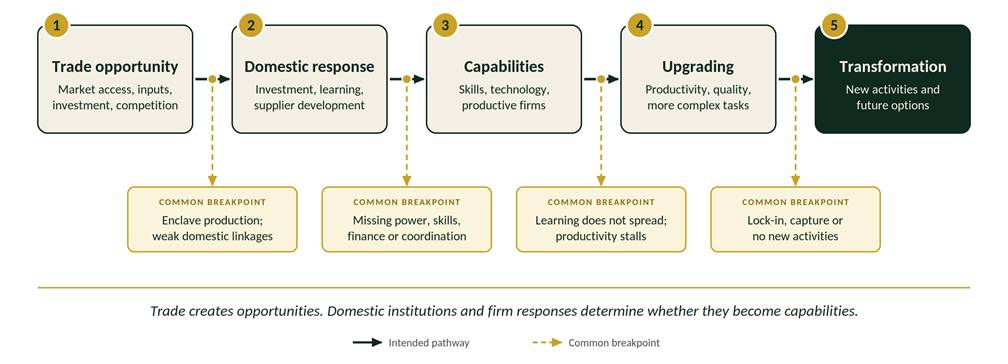
Figure 1. The causal pathway from trade opportunity to structural transformation. Dashed arrows indicate common breakpoints.
The analytical distinction: expansion, upgrading and transformation
The term ‘transformative trade’ should be used with care. It is not presented as a wholly new theory. It applies the established literature on structural transformation and productive capabilities to the evaluation of trade outcomes and trade-related interventions.
| Category | Observable change | Evidence required | What remains unproven |
| Trade expansion | More exports or imports, higher trade-to-GDP ratio, new markets or investment. | Trade values and volumes, market access, export participation. | Whether domestic productivity or capabilities have improved. |
| Trade upgrading | Movement into processed goods, higher-quality products or more complex tasks. | Product composition, unit values interpreted carefully, task and quality changes. | Whether learning, ownership, supplier links or future options have deepened. |
| Transformative trade | Trade contributes to durable capabilities and makes further productive activities feasible. | Evidence of learning, productivity, supplier development, diffusion, diversification and persistence over time. | Causation still requires a credible account of what would have happened otherwise. |
This distinction prevents two common analytical shortcuts. The first is to equate processing with transformation. Processing can retain more value locally, but its developmental contribution depends on the depth of domestic capability and the scope for moving into related tasks. The second is to equate domestic ownership with transformation. Domestic ownership may matter for control and income distribution, but a locally owned firm can remain technologically stagnant, unproductive or weakly connected to the wider economy. The test must examine actual capabilities and effects, not rely on a proxy.
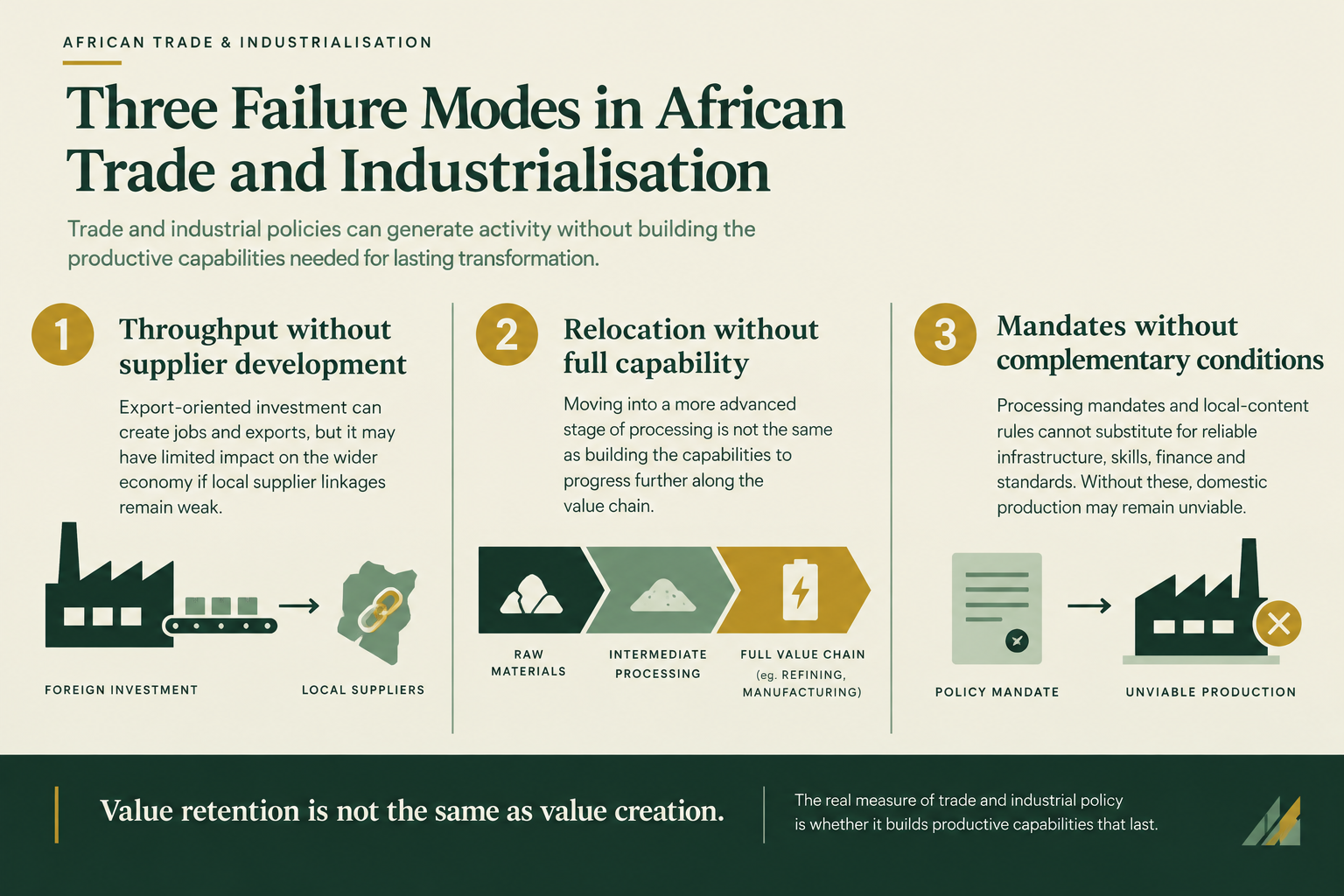
Three failure modes in African trade and industrialisation
The first is the expansion of production without corresponding development of domestic suppliers. Ethiopia’s industrial parks illustrate the distinction between the performance of firms operating within an investment project and its wider contribution to the national economy. An independent evaluation found that the parks had made no major contribution to national job creation or export performance during the period assessed. In fiscal year 2019/20, they generated approximately 90,000 jobs and accounted for 5.1 per cent of total goods exports, while opportunities remained to strengthen linkages with nearby micro and small enterprises.[7]These findings highlight the need to distinguish the establishment of export-oriented production from the development of a broader domestic productive base. Industrial parks may generate employment, exports and local demand, yet their contribution to transformation depends partly on whether domestic firms can supply their inputs, meet buyers’ requirements and acquire capabilities through commercial relationships. Where imported intermediate inputs predominate, opportunities for local firms to participate in production networks and learn from more advanced enterprises may remain limited. A low domestic sourcing share can therefore signal weak productive linkages, although it does not, by itself, establish the overall causal impact of an industrial park.
A second challenge arises when production moves into a more advanced stage without generating the capabilities needed to progress further along the value chain. The Democratic Republic of the Congo’s cobalt sector illustrates this distinction. The displacement of cobalt ores and concentrates by cobalt hydroxide in the country’s export profile represents a shift towards a further stage of processing within the domestic economy. However, cobalt hydroxide remains an intermediate product, and substantial stages of the battery value chain extend beyond its production. These include refining, precursor and cathode production, cell manufacturing, engineering, testing and recycling.[8]
The significance of this distinction lies in the difference between undertaking additional processing and developing the technological, organisational and industrial capabilities required to participate in more complex activities. Africa’s Green Minerals Strategy recognises this challenge by advancing an ambition to move beyond raw mineral exports towards value addition at source, integrated value chains and regional industrialisation. Among its proposed instruments are local-content recognition, investment in critical skills and innovation, and temporary infant-industry protection.[9] These proposals reflect an effort to connect mineral production with broader industrial development. Their effectiveness, however, depends on the conditions under which they are implemented and whether they generate sustainable improvements in domestic productive capacity. Mandates without complementary conditions
A third challenge is the use of processing mandates and local-content requirements without the complementary conditions needed to make domestic production viable. Such requirements cannot independently provide reliable electricity, transport, water, finance, skilled labour or the standards infrastructure necessary for competitive production. This is particularly consequential in energy-intensive industries, where electricity shortages can undermine the cost and reliability of domestic processing. Africa’s Green Minerals Strategy identifies power constraints affecting nickel exports in Zimbabwe and drought-related hydropower shortfalls in Zambia and Zimbabwe as examples of the infrastructure challenges facing mineral-based industrialisation.[10] Where these constraints remain unresolved, requirements to process minerals domestically may increase production costs without establishing a commercially viable industry. Local-content rules and processing mandates must therefore be accompanied by investments in productive infrastructure, workforce capabilities and the institutions required to support industrial development. Their success should be assessed by whether domestic production becomes progressively more competitive and capable of generating wider economic benefits, rather than by compliance with the requirements alone.
Taken together, these cases demonstrate that value retention and value creation are distinct objectives. A country may retain a greater share of a value chain within its borders without achieving substantial improvements in productivity, technological capability or economic diversification. Conversely, reliance on imported inputs does not necessarily undermine transformation where those inputs enable domestic firms to learn, produce competitively and develop capabilities that support entry into more sophisticated activities. The central policy challenge is therefore to establish the conditions under which participation in trade and global value chains strengthens the domestic productive base over time. This requires evaluating industrial initiatives by the capabilities they develop, the linkages they establish and the opportunities they create for further productive upgrading.
A four-part test for transformative trade
The proposed test asks four questions: value, capability, linkage, and absorption and dynamism. The first three examine how value and productive knowledge are generated and distributed. The fourth examines whether the activity changes the economy’s future productive options. They are analytically distinct but empirically connected.[11]
| Dimension | Analytical question | Useful indicators | Main interpretive risk |
| 1. Value | What value is created and retained domestically or regionally? | Domestic value added in exports; wages and profits; tax contribution; local ownership of key functions; import content; value captured in logistics and services. | Gross export value can rise while domestic value added remains low. Domestic value added alone does not reveal distribution or capability. |
| 2. Capability | What can firms, workers and institutions do better because of the activity? | Productivity; technical and managerial skills; certification; technology adoption; maintenance and engineering capacity; R&D; movement into complex tasks. | Training or R&D spending is an input, not proof of learning or effective use. |
| 3. Linkage | Does the activity create viable opportunities for domestic and regional suppliers? | Domestic and intra-African sourcing; repeat contracts; supplier survival and productivity; new firms; procurement by size and input category. | Supplier counts can increase without productivity, quality or additionality. |
| 4. Absorption and dynamism | Does labour move into more productive work, and do new activities become feasible? | Employment and productivity by sector; real wages and job quality; new products and tasks; export diversification; firm entry and survival; adjacent industries. | Diversification can be superficial, and employment shifts do not guarantee productivity gains. |
The test is diagnostic, not a single score. A composite index would risk hiding trade-offs: high local value added might coexist with low productivity; strong export growth might coexist with weak wages; a new supplier base might depend on permanent protection. The purpose is to force explicit reasoning about the mechanism and the evidence.
Applying the test to Ethiopia’s recent export growth
Ethiopia provides a useful live example because recent reforms and export growth create a risk of drawing a conclusion from trade figures alone. The value of goods exports had more than doubled since the start of the reform programme, according to a review published in July 2026.[12] That is evidence of a substantial change in export value. It is not, by itself, evidence that structural transformation has occurred.
| Test dimension | What the available evidence can establish | What must still be established |
| Value | Export value has risen substantially. | Domestic value added, import content, distribution of earnings and tax contribution by sector. |
| Capability | Export-oriented production exists and the economy is changing. | Whether firms and workers have acquired technical capabilities, productivity has improved, and more complex tasks are performed locally. |
| Linkage | Industrial parks have created production and some nearby business opportunities. | Current domestic sourcing by input category, repeat supplier contracts, supplier productivity and regional sourcing. |
| Absorption and dynamism | Exports and labour allocation are changing. | Whether labour is entering higher-productivity jobs, whether job quality and real wages are improving, and whether new activities are emerging. |
The disciplined verdict is therefore limited but useful: Ethiopia has recorded export expansion, while the evidence cited here is insufficient to conclude that recent reforms have generated broad-based capability formation. The industrial-park evidence raises questions about supplier linkages, but it should not be mechanically generalised to every export sector or to the post-reform period.
A policy protocol: how to make the test operational
The four-part test becomes useful when it changes the questions asked before and after a policy is adopted. Any trade-related intervention seeking a developmental justification should state the following.
| Required element | Question to answer | Evidence or safeguard |
| Capability objective | What specific productive capability should exist that does not currently exist, or is too weak? | Baseline and a defined outcome, not a general promise of industrialisation. |
| Causal mechanism | How is the instrument expected to produce that capability? | A theory of change connecting the measure to investment, learning, suppliers or productivity. |
| Complementary conditions | What must also be in place? | Named constraints, responsible institutions, budget and delivery timetable. |
| Performance milestones | What would count as progress at early, intermediate and later stages? | Measurable indicators, disaggregated where possible by firm size, gender, region and job quality. |
| Cost and alternatives | What are the fiscal, consumer, environmental and opportunity costs? | Published cost estimates and comparison with less restrictive or less costly instruments. |
| Review and exit | What triggers redesign, reduction or withdrawal? | A review date, independent evaluation where feasible and safeguards against capture. |
| Legal and regional fit | Is the measure consistent with applicable domestic, regional and WTO obligations, and does it support regional production? | Legal review, notification where required, and assessment of effects on neighbouring producers and consumers. |
The protocol is intentionally demanding because the language of capability can be used to defend almost any intervention. A credible developmental claim must be specific enough to fail. The state should identify the capability, the mechanism, the cost and the point at which the policy will be reconsidered.
A framework for transformative trade must address the concern that it could provide a justification for protectionism. Its argument, however, is conditional. Support for domestic production is justified only where it serves a specific capability objective and provides a credible mechanism through which firms can learn, improve and become more competitive. Such support must also be subject to defined timelines, measurable milestones and periodic review. Where firms repeatedly fail to demonstrate progress, continued support becomes difficult to justify. Similarly, where domestic production is structurally uncompetitive, and there is no plausible pathway through which productive capabilities can develop, importing may offer greater economic benefits than sustaining inefficient production.
A further challenge concerns the time required for productive capabilities to emerge. Industrial upgrading can involve long gestation periods, particularly where it depends on technological learning, workforce development, infrastructure or the establishment of domestic supplier networks. These time horizons, however, do not justify indefinite support. They require a staged approach to evaluation, with early indicators assessing whether the necessary conditions for learning and capability development are taking shape, and later indicators examining improvements in productivity, diversification and the capacity to enter related, higher-value activities. Although the appropriate timeframe will vary across sectors, support must remain accountable to evidence of progress towards its stated objectives.
In conclusion, transformative trade is best understood as a demanding evaluative proposition. That is, trade is transformative when it contributes to durable productive capabilities and expands the range of activities an economy can sustain in the future. The four-part test, value, capability, linkage, and absorption and dynamism, makes that proposition practical. It directs attention to what trade enables, who learns, where value accrues, which constraints remain and whether the next stage of upgrading becomes more feasible.
The decisive question is therefore not only how much an economy trades, or even what it exports. It is what the economy becomes able to produce, improve and sustain because it trades.
[1] Hollis Chenery and Moises Syrquin, Patterns of Development, 1950–1970 (Oxford University Press for the World Bank 1975); W Arthur Lewis, ‘Economic Development with Unlimited Supplies of Labour’ (1954) 22 The Manchester School 139; Margaret S McMillan and Dani Rodrik, ‘Globalization, Structural Change and Productivity Growth’ (NBER Working Paper No 17143, 2011).
[2] Xinshen Diao, Margaret McMillan and Dani Rodrik, ‘The Recent Growth Boom in Developing Economies: A Structural Change Perspective’ (NBER Working Paper No 23132, 2017) <https://www.nber.org/papers/w23132>; Gaaitzen de Vries, Marcel Timmer and Klaas de Vries, ‘Structural Transformation in Africa: Static Gains, Dynamic Losses’ (2015) 51 Journal of Development Studies 674.
[3] Gaaitzen de Vries, Marcel Timmer and Klaas de Vries, ‘Structural Transformation in Africa: Static Gains, Dynamic Losses’ (2015) 51 Journal of Development Studies 674.
[4] African Union Commission, Africa’s Green Minerals Strategy (December 2024) (AGMS) 57 < https://www.au.int/en/documents/20250318/africas-green-minerals-strategy-agms >.
[5] Matthias Busse, Stanley Kojo Dary and Jan Wüstenfeld, ‘Trade Liberalisation and Manufacturing Employment in Developing Countries’ (2024) 70 Structural Change and Economic Dynamics 410 https://doi.org/10.1016/j.strueco.2024.05.003.
[6] Albert O Hirschman, The Strategy of Economic Development (Yale University Press 1958); Ricardo Hausmann and Dani Rodrik, ‘Economic Development as Self-Discovery’ (2003) 72 Journal of Development Economics 603.
[7] World Bank Independent Evaluation Group, ‘World Bank Group’s Efforts to Expand Ethiopia’s Private Sector’, ch 3 < https://ieg.worldbankgroup.org/evaluations/world-bank-group-ethiopia-fiscal-years-2013-23/chapter-3-world-bank-groups-efforts >
[8] AGMS (n 3) 43 (displacement of cobalt ores and concentrates by cobalt hydroxide) and 67 (missing midstream stages of the battery value chain).
[9] AGMS (n 3) iii, 84, 86, 90.
[10] AGMS (n 3) 50–51 (power shortages affecting nickel exports in Zimbabwe, and drought related hydropower shortfalls in Zambia and Zimbabwe).
[11] On the measurement of diversification and the relatedness of new products to existing capabilities, see César A Hidalgo and Ricardo Hausmann, ‘The Building Blocks of Economic Complexity’ (2009) 106 Proceedings of the National Academy of Sciences 10570.
[12] International Monetary Fund, ‘Ethiopia: IMF Completes the Fifth Review under the Extended Credit Facility Arrangement’ (Press Release, 1 July 2026) < https://www.imf.org/en/news/articles/2026/07/01/pr26235-ethiopia-imf-completes-5th-review-under-ecf-arrangement >.