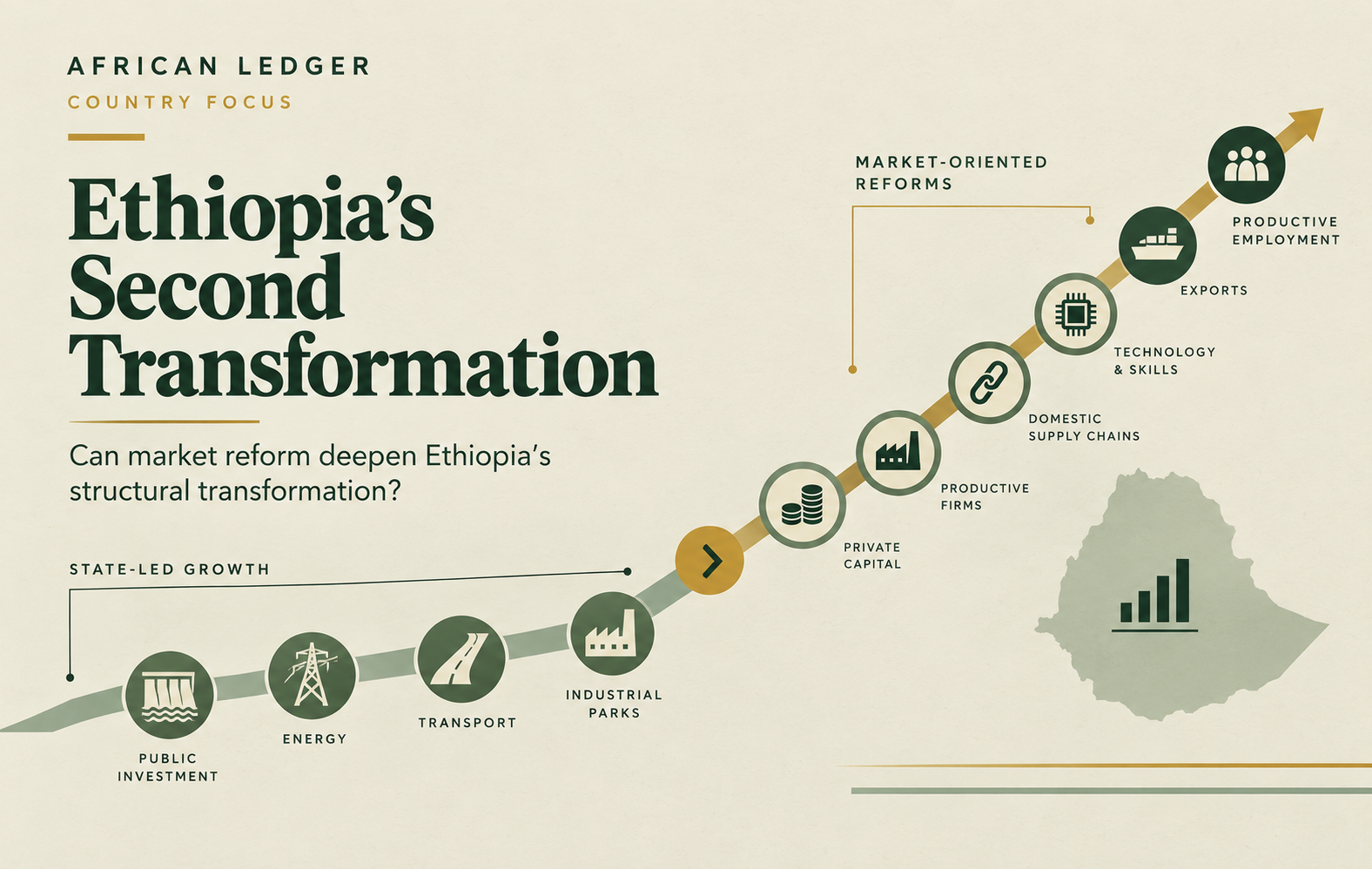

Ethiopia is moving from a development model centred on public investment and state direction towards a more market-oriented economic framework. The central issue is whether this transition can deepen the structural transformation that the earlier model sought to achieve.
Ethiopia's economic trajectory over the past two decades has been characterised by rapid growth, extensive public investment and an ambitious programme of structural change. The state invested heavily in transport, electricity and other infrastructure while promoting industrialisation as a means of diversifying production, expanding exports and creating employment outside agriculture. This approach generated substantial economic expansion and established important foundations for industrial development. It also produced fiscal, external and financial pressures and did not generate productive employment at the scale required by Ethiopia's rapidly expanding working-age population.
Since 2024, Ethiopia has begun a significant reorientation of its economic policy. The Home-Grown Economic Reform Agenda 2.0 seeks to establish a more market-oriented and rules-based economic system, with reforms covering macroeconomic policy, investment and trade, productive sectors and public-sector governance. The Ethiopian Prime Minister's Office identifies macroeconomic stability, resilience, productivity and structural transformation among the principal objectives of the programme. The International Monetary Fund's recent assessment similarly characterises the reforms as a transition towards a more competitive and market-oriented economic framework.
The significance of this transition extends beyond the immediate objectives of macroeconomic stabilisation. Ethiopia is attempting to alter the institutional arrangements through which investment, production and resource allocation occur while addressing structural weaknesses inherited from the previous development model. Its experience therefore provides a useful case for examining a central question in African development, that is, how can economic reform produce structural transformation rather than simply restore macroeconomic stability and accelerate aggregate growth?
The limits of the first transformation
Ethiopia's earlier development strategy was based on an active developmental state. The government sought to overcome constraints to investment by mobilising public resources, expanding infrastructure and directing investment towards sectors considered important for long-term transformation. Industrial parks formed an important component of this strategy, particularly in textiles, garments, leather and agro-processing.
The underlying objective was broader than increasing manufacturing output. Industrialisation was expected to facilitate the movement of labour from agriculture into higher-productivity activities, generate foreign exchange, develop technological and managerial capabilities and create domestic linkages between firms. In structural-transformation terms, the objective was to alter the composition and productive capacity of the economy.
The results have been mixed. Ethiopia achieved rapid economic growth and significant improvements in infrastructure, while structural change proceeded at a more limited pace. The African Development Bank's assessment of Ethiopia's structural transformation notes that agriculture continued to account for a substantial proportion of employment while manufacturing remained relatively small as a share of economic output.
The experience of the industrial parks illustrates this limitation. Industrial parks attracted foreign manufacturers and generated employment and exports, but their connections with the domestic economy remained limited. A World Bank assessment found that domestic firms supplied less than 5 percent of intermediate inputs used by industrial-park investors in 2021.
The distinction is important. Industrial production can increase without creating a sufficiently broad industrial ecosystem. A factory may employ workers and export goods while importing most of its machinery, materials and intermediate inputs. The economy gains production capacity at the factory level, while domestic firms may acquire limited technological capabilities and capture a relatively small proportion of the value generated along the wider production chain.
Structural transformation requires these connections to deepen over time. Productive activities need to generate demand for domestic suppliers, develop skills, encourage technology adoption and create opportunities for firms to enter increasingly sophisticated activities.
The second transformation
The reforms initiated in 2024 have changed the environment in which this challenge must be addressed.
Ethiopia has moved towards a more flexible foreign-exchange regime, undertaken monetary and fiscal reforms, opened additional sectors to private and foreign participation and begun restructuring state-owned enterprises. Foreign participation in banking has been permitted, while investment and trade regulations are being revised to increase competition and attract capital.
The reforms have already produced measurable macroeconomic changes. According to the IMF's July 2026 review, the value of goods exports has more than doubled since the beginning of the reform programme, while international reserves have increased substantially. Fiscal performance has also improved, supported by stronger domestic revenue mobilisation.
These developments are relevant to structural transformation because macroeconomic instability can restrict productive investment. Foreign-exchange shortages can prevent firms from importing machinery and intermediate goods. Exchange-rate distortions can weaken investment incentives. Fiscal constraints can limit public investment in infrastructure and skills. Improving these conditions can therefore remove important barriers to private-sector expansion.
Macroeconomic reform, however, addresses the environment in which production takes place. It does not determine the structure of production that emerges from that environment. That distinction places greater importance on the allocation and composition of private investment.
From investment to productive capability
Ethiopia requires substantial private investment to sustain its next phase of development. Firms need to expand production, employ workers, adopt technology and enter domestic and international markets. The World Bank's 2027–2036 country strategy places private-sector development and job creation at the centre of its engagement with Ethiopia, identifying agriculture, manufacturing, energy and digital services as sectors with significant employment potential.
The scale of the employment challenge is considerable. More than two million Ethiopians enter the labour market each year, according to the World Bank. Agriculture continues to employ a large proportion of the workforce, which means that the productivity of agriculture and the capacity of other sectors to absorb labour will remain central to the country's development trajectory.
This makes the composition of investment particularly important. The relevant question is not simply whether capital is entering the economy, but whether it is generating capabilities that raise productivity over time.
Investment in agro-processing, for example, can connect agricultural production with manufacturing and logistics. Investment in manufacturing can create demand for domestic suppliers. Improvements in transport infrastructure can expand the geographical reach of firms. Digital infrastructure can reduce transaction costs and facilitate access to markets. Skills development can allow workers and firms to move into more sophisticated activities.
These relationships are central to structural transformation because productivity gains in one sector can create opportunities in others. The objective is to develop an economy in which productive activities become increasingly interconnected, and the capabilities of domestic firms deepen over time.
The employment test
Employment provides one of the clearest measures of whether Ethiopia's economic transformation is becoming structural.
The World Bank's assessment of Ethiopia's labour market indicates that labour has continued to move away from agriculture, with services absorbing much of the transition. This movement has contributed to improvements in household welfare, but the creation of productive wage employment has remained insufficient.
The distinction between sectoral movement and productivity growth is important. Workers can leave agriculture without moving into high-productivity activities. If labour is absorbed primarily into low-productivity informal services, the composition of employment changes while the productive capabilities of the economy improve only modestly.
Ethiopia therefore faces two related objectives. Agricultural productivity needs to increase, while manufacturing, agro-processing and modern services need to expand sufficiently to provide productive employment for workers entering the non-agricultural economy. This requires more than employment creation in isolation. The quality and productivity of that employment determine whether labour reallocation contributes to sustained increases in living standards and national productive capacity.
Infrastructure and the productive economy
Ethiopia's large infrastructure investments remain an important foundation for this process. Roads, electricity, railways and logistics infrastructure reduce production and transaction costs and can connect firms to domestic and international markets.
The development of the Modjo Dry Port illustrates the potential effect. The World Bank reports that improvements at the facility have reduced processing times for some goods from approximately 60 days to 15 days. The expansion is also intended to strengthen the country's export logistics. Such improvements can increase competitiveness. Their developmental significance ultimately depends on how firms use the resulting reductions in costs.
Lower logistics costs can facilitate the export of agricultural commodities, manufactured goods and processed products. They can also enable firms to source inputs from a wider geographical area and participate more effectively in regional and international value chains. The extent to which these opportunities translate into higher domestic value addition and stronger capabilities will determine their contribution to structural transformation.
Infrastructure therefore constitutes an important enabling condition. It does not, by itself, determine the sophistication of the productive activities that emerge around it.
Reconsidering the role of the state
Ethiopia's transition also raises a broader question concerning the role of the state in structural transformation.
The conventional distinction between state-led and market-led development provides an incomplete description of the policy choices facing the country. The earlier Ethiopian model demonstrated the state's capacity to mobilise resources and coordinate investment at scale. Its weaknesses demonstrated the fiscal and external pressures that can emerge when public investment becomes the principal engine of economic expansion. The current reforms are increasing the role of private capital in investment and production. This does not eliminate the need for public coordination.
A state seeking to promote structural transformation can influence the direction and quality of private investment through infrastructure, skills development, standards, trade policy, public procurement, development finance and industrial coordination. It can address coordination problems that individual firms are unable to resolve independently and create conditions in which domestic firms can develop capabilities alongside larger investors. The institutional challenge is therefore to determine how the state can exercise strategic influence without reproducing the distortions associated with excessive administrative control.
This is particularly important for Ethiopia because the weaknesses identified in the earlier industrialisation strategy remain relevant. The World Bank's analysis of Ethiopia's special economic zones emphasises the importance of employment, exports, technology transfer and backward and forward linkages in evaluating industrial-zone performance.
These criteria point towards a broader understanding of industrial policy. The objective is to create the conditions under which those firms contribute to a progressively more capable domestic economy.
What will determine the second transformation?
Ethiopia's recent reforms have produced evidence of improving macroeconomic conditions. Export growth has accelerated, foreign-exchange conditions have improved and fiscal performance has strengthened. The government has also sought to increase private investment and reduce the financial and administrative constraints that previously limited firms. The more difficult test concerns the productive structure that emerges from these reforms.
Ethiopia needs to create productive employment for a rapidly expanding labour force, increase agricultural productivity, develop manufacturing beyond relatively narrow industrial enclaves and strengthen the connections between domestic firms and international investors. It also needs to develop the technological, managerial and institutional capabilities required for firms to move into higher-value activities.
These objectives require continuity between macroeconomic reform and industrial policy. Stabilisation can create the conditions for investment, while productive-sector policies can influence the direction in which investment develops. The relationship between the two will be central to whether Ethiopia's current transition produces sustained structural change.
The country's earlier development model established important foundations. Infrastructure expanded, productive investment increased and manufacturing gained a stronger position within national development policy. Its limitations demonstrate the difficulty of translating investment and industrial expansion into broad-based productive capabilities.
The current reform programme therefore represents a second stage in Ethiopia's development trajectory. Its success will depend on whether a more competitive economic environment can generate deeper domestic linkages, higher productivity, stronger firms and more productive employment.
For Ethiopia, structural transformation ultimately concerns the composition and capabilities of the economy. The relevant indicators will be found in the movement of labour, the productivity of firms, the sophistication of exports, the depth of domestic supply chains, the adoption of technology and the ability of Ethiopian enterprises to compete in increasingly demanding markets.
The central question for the country's second transformation is therefore straightforward. Can Ethiopia convert macroeconomic reform and private investment into a sustained expansion of productive capability? The answer will determine whether the country is entering a new phase of structural transformation or simply a new phase of economic growth.