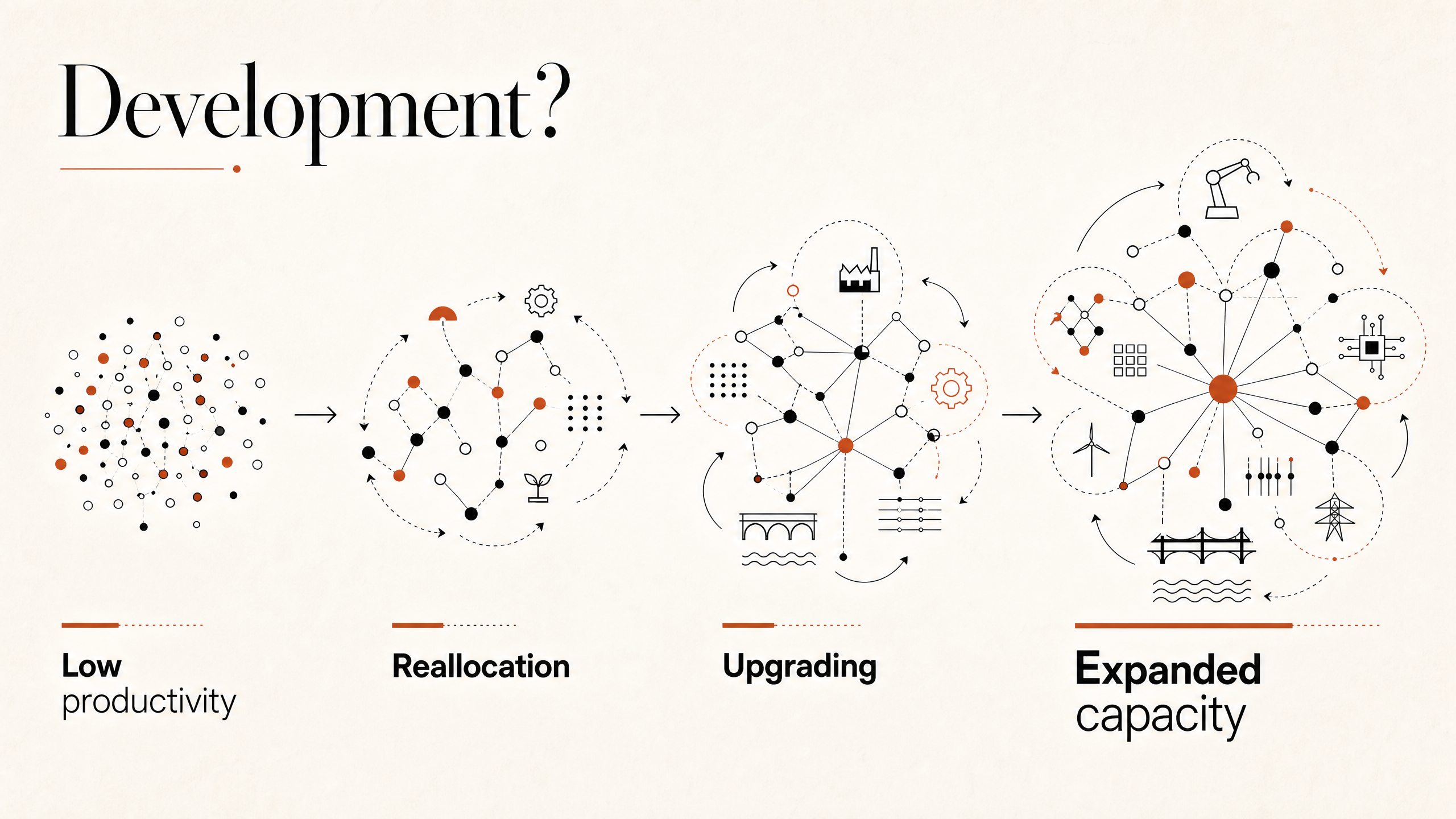

Development?
Development cannot simply be reduced to economic growth alone. Growth tells us that an economy has become larger. It does not, by itself, tell us what changed in the economy to make it larger, whether those changes can be sustained, or whether the economy has acquired the capacity to become more productive in the future. An economy may grow because of a temporary rise in commodity prices, the depletion of a natural resource, or an expansion of activity that creates little new productive capability.[1] There must therefore be more to development than an increase in output. We must ask what has happened to the productive structure that generated that output and what the economy is now capable of doing that it could not do before. Growth is neither a sufficient nor a complete account of development.[2]
Development also cannot be reduced entirely to human flourishing. Human flourishing is an important conception of the purpose of development, but it is ultimately a normative conception of the good life. It asks what people should be capable of doing and being, rather than how an economy develops the productive means necessary to make those possibilities attainable.[3] That distinction matters. The question of what constitutes a good life cannot be answered by economics alone, but neither can the material conditions necessary for such a life be wished into existence.
Health, education, leisure, security, freedom and human agency all require, to varying degrees, an economy capable of generating the resources necessary to sustain them. Our concern is therefore not to deny the normative importance of human flourishing, but to examine the economic foundations upon which many of its material dimensions depend. A society cannot meaningfully expand the substantive choices available to its people without some productive foundation from which those choices can be financed and sustained. Human flourishing may therefore represent an ultimate purpose of development. Still, it cannot eliminate the prior economic question: how does a society build the productive capacity that makes greater human possibility materially achievable?
This is the question that concerns us here. That is not to dismiss the other 2 conceptions of development; however, one must understand why the ledger adopts the notion of development that it adopts.
The starting point is therefore not simply how much an economy produces, nor immediately what kind of life its people ought to live. It is what the economy is capable of producing, how that capability changes, and how labour and other productive resources are organised in the process.
Development, in this sense, must then be, fundamentally, a transformation of the productive structure.[4] It occurs when an economy increasingly directs its labour and productive resources towards activities that generate greater productive value and, importantly, expand the economy's capacity for further productive activity.
Let us unpack this.
The first point is that development entails a transformation in the allocation and use of productive resources. There are two related ways in which this can come about.
The first is structural reallocation. That is, the movement of labour and other productive resources from one economic activity into another with greater productive potential.[5] Assuming, for example, that we have a farmer with the necessary skills and expertise to move between agriculture and manufacturing, that worker may move from farming into a company specialising in the production of semiconductors. The developmental significance of this movement does not lie simply in the occupation itself. It lies in the production system into which the worker moves. Labour can become more productive when combined with the capital, technology, knowledge, infrastructure and organisation that enable the new activity to generate a greater productive contribution. The movement of the worker is therefore not, in itself, what creates development. Rather, it is the movement of labour into a production system capable of making more productive use of that labour.
The second is productive upgrading. That is, increasing the productivity of resources within an existing activity.[6] A farmer need not leave agriculture for manufacturing to become more productive. Suppose instead of moving the farmer from the farm, a tractor is introduced to assist with farming activities. In this instance, there is also a greater productive contribution from the same labour without necessarily moving the worker from agriculture, because the conditions under which production takes place have changed, enabling the labour and other resources employed to generate more output and productive value. Improved seed varieties, irrigation, digital technologies, better management and new production methods can produce the same effect. In this case, the productive structure changes not because labour moves between sectors, but because the productive capacity of an existing activity is upgraded.
Structural reallocation and productive upgrading should therefore be understood as two mechanisms of the same broader process, productive transformation. Development can therefore occur both through the movement of resources between activities and through changes in the productivity of resources within existing activities.
This brings us to the more difficult question of what productive value means.
Productive value cannot simply be equated with the market price or revenue generated by an activity. Market prices can reflect scarcity, market power, monopoly rents or resource ownership without corresponding to an increase in productive capacity.[7] Conversely, some activities generate knowledge, skills, organisational capabilities or other benefits whose contribution is not fully captured by their market price. The pertinent question is therefore not simply how much an activity is worth in the market, but what it contributes to the economy's capacity to produce.
Productive value is therefore concerned with the contribution an activity makes to an economy's present and future productive capacity relative to the resources required to sustain it. Simply put, productive value concerns the productive contribution generated relative to the resources committed to generating it.
But this still leaves open the question of what exactly constitutes the productive contribution being compared. If it is reduced simply to economic value, the concept risks falling back into the same problem as GDP. It would be measuring what is produced without adequately asking what an activity contributes to the economy's productive development.[8] The productive contribution should instead concern what an activity adds to the economy's ability to produce, learn and undertake further productive activity. It may include the production of goods and services, and the value added generated in the process, but also, where relevant, technological improvement, the acquisition and application of knowledge and skills, organisational capability, supplier linkages and the creation of new productive activities that expand what the economy can produce in the future.
The corresponding resource cost is what the economy commits to producing that contribution. This may include labour, capital, land, energy, infrastructure, natural resources and technological inputs. The concern is therefore not simply with how much an activity produces, but with the productive contribution generated in relation to the resources committed to generating it.
This also introduces a distinction between current productive contribution and dynamic productive contribution. An activity may generate substantial output today without significantly expanding the productive capabilities available tomorrow. Another may produce less immediate output while generating skills, technological knowledge, supplier networks or other capabilities that enable more productive activities to emerge later. Development must therefore be concerned not only with what an economy produces today, but with what its present activities make possible tomorrow.[9]
Development, consequently, cannot be static. It must be dynamic in the sense that the transformation is capable of being sustained and built upon across time. An activity that produces a temporary increase in output but leaves the economy no more capable of producing, learning or diversifying in the future represents a fundamentally different process from one that creates capabilities upon which subsequent productive activity can build. Development therefore involves not merely increasing present productive output, but expanding the economy's capacity to produce more, learn more and undertake more productive activities in the future.
The question of development then becomes a question of transformation. What productive activities does an economy possess, how productive are they, how are labour and other resources allocated among them, what capabilities and linkages do they create, what new activities can those capabilities enable and what prevents more productive activities from emerging and expanding at sufficient scale?
The metrics of this development?
The usefulness of this conception is that it is not merely normative. It gives us a way of thinking about development that can be investigated empirically. If development is a transformation of the productive structure, then we should be able to observe changes in that structure and examine whether those changes are moving the economy towards more productive uses of its resources.
The first thing we can observe is structural reallocation. We can examine where labour and other productive resources are located and how that distribution changes over time. If a large share of the labour force moves from low-productivity agriculture into manufacturing, higher-productivity services or other productive activities, that movement can be measured. We can therefore ask not merely whether employment has increased, but whether workers are moving into activities capable of making more productive use of their labour. The same question can be asked of capital, investment and other productive resources: where are they being directed, and what kinds of activities are they enabling?
We can then examine productivity within those activities. Output and value added can be compared with the labour, capital and other resources used to produce them. This allows us to ask whether workers are becoming more productive within existing activities and whether resources are being used more efficiently. A farmer who produces twice as much because of improved machinery, irrigation or production methods has experienced productive upgrading even though neither the farmer nor the sector has changed. Similarly, a worker who moves from a low-productivity activity into a production system with greater capital, technology and organisational capacity may generate a greater productive contribution without any change in the worker's basic skills.
The more difficult question concerns the productive capabilities created by these activities. Not everything that matters for development appears immediately in current output. An activity may train workers, introduce new technologies, develop managerial expertise, establish domestic suppliers or create knowledge that can subsequently be applied elsewhere in the economy. These effects can be investigated through indicators such as skills and training, technology adoption, research and development, domestic input and supplier linkages, export diversification and the emergence of new industries and productive activities.[10] These indicators do not provide a perfect measure of future productive capacity, but they allow us to examine whether present economic activity is creating capabilities upon which future production can build.
This also allows us to distinguish between growth that increases present output and transformation that expands future productive capacity. An economy may experience rapid growth while its productive structure changes very little. It may also experience a temporary increase in output from the extraction of a natural resource without acquiring significant new capabilities to produce, learn or diversify.[11] Conversely, an activity may generate more modest output in the present while creating skills, technology and productive linkages that enable substantially greater production in the future. Our conception therefore asks us to examine not only how much an economy produces, but what its productive activities are doing to the economy's capacity to produce more and differently over time.
No single indicator can capture development in its entirety, and productive value should not be mistaken for a statistic that can simply be read from a national accounts table. The point is different. The underlying processes that constitute productive transformation are observable. We can examine where labour and capital are moving, how productivity is changing, what capabilities are being created, what linkages are developing and whether new productive activities are emerging. Development therefore becomes something that can be measured, compared and investigated, rather than a condition that must simply be asserted after observing that GDP has risen or that some broader measure of human welfare has improved.
Why This Conception Matters for Africa
The usefulness of a conception of development is ultimately tested by what it allows us to see. For Africa, understanding development as productive transformation is particularly useful because the continent's central economic challenge is not simply a shortage of labour or even a shortage of employment. It is the difficulty of moving a large and growing labour force into activities capable of making substantially more productive use of that labour.[12]
Africa therefore presents a particularly important case for a conception of development concerned with the transformation of the productive structure. The continent possesses abundant labour and considerable productive resources, yet much of this remains concentrated in activities characterised by low productivity, while the activities capable of generating substantially greater productive value often remain limited in scale.[13] The question is consequently not simply whether Africans are working. It is what the economy enables those workers to produce.
This distinction is important because movement between occupations does not necessarily constitute development. A worker may leave subsistence agriculture and enter informal retail, transport or another low-productivity service. The worker has changed occupations, but the economy may not have made substantially better use of that worker's productive capacity. Structural transformation therefore cannot be understood simply as the movement of labour out of one sector and into another. What matters is whether labour is moving into, or existing activities are being transformed into, production systems capable of generating greater productive value.
This is why the distinction between structural reallocation and productive upgrading matters particularly for Africa. The first involves moving labour and other resources into more productive activities. The second involves increasing the productivity of resources within activities in which they are already employed. A farmer who moves into a manufacturing plant may become more productive because the new production system provides greater access to capital, technology, infrastructure and organisational capabilities. But a farmer who remains on the farm may also become more productive if irrigation, machinery, improved seeds or better production methods transform the conditions under which production takes place. Africa therefore needs both movements between activities and transformations within them.
The difficulty, however, is that labour cannot be moved into productive activities that do not exist at sufficient scale. This makes the creation of productive activities just as important as the movement of labour between them. An economy may possess workers with the capacity to undertake more productive work, but if the economy does not create firms, industries and production systems capable of employing them, that potential remains unrealised. The development question therefore cannot be reduced to making workers more skilled or more employable. It must also ask whether the productive structure is generating sufficient opportunities in which those skills and abilities can be productively deployed.
This is particularly important given Africa's growing labour force.[14] The continent will not achieve development merely by ensuring that its expanding workforce finds some form of employment. It must continually expand the number and range of activities capable of absorbing labour at progressively higher levels of productivity. The challenge is therefore one of productive absorption. That is, creating an economy capable of taking the labour and resources available to it and continually incorporating them into more productive forms of economic activity.
The distinction between present and future productive value makes this problem even clearer. An activity may generate substantial output today without significantly expanding the economy's ability to produce tomorrow. Conversely, an activity may generate more modest immediate output while creating skills, technological knowledge, supplier relationships, organisational capabilities or other conditions from which further productive activities can emerge. For an economy seeking sustained transformation, the latter contribution matters because development depends not only on what an economy can produce now, but on what its present productive structure enables it to produce next.
This gives the African development question a distinctly dynamic character. The objective is not simply to identify activities that are productive today. It is to build a productive structure capable of continually generating and expanding activities that are more productive than those that came before. The relevant question is therefore not merely whether Africa has high-productivity sectors. It is whether those sectors can expand, whether new ones can emerge, whether existing activities can be upgraded, and whether these processes can absorb an increasing share of the continent's labour and productive resources.[15]
This is why the conception advanced in this essay is particularly applicable to Africa. It places the central development question where it arguably belongs: whether Africa is becoming better at producing, whether it is creating new productive capabilities, and whether its growing labour force is being progressively incorporated into that transformation.
The problem is therefore how to build an African economy capable of making them productive.
[1] Jeffrey D Sachs and Andrew M Warner, 'Natural Resource Abundance and Economic Growth' (NBER Working Paper No 5398, 1995).
[2] Dudley Seers, 'The Meaning of Development' (1969) 11(4) International Development Review 2.
[3] Amartya Sen, Development as Freedom (Alfred A Knopf 1999).
[4] Hollis Chenery and Moises Syrquin, Patterns of Development, 1950–1970 (Oxford University Press for the World Bank 1975).
[5] W Arthur Lewis, 'Economic Development with Unlimited Supplies of Labour' (1954) 22(2) The Manchester School 139.
[6] Margaret S McMillan and Dani Rodrik, 'Globalization, Structural Change and Productivity Growth' (NBER Working Paper No 17143, 2011).
[7] Joseph E Stiglitz, Amartya Sen and Jean-Paul Fitoussi, Report by the Commission on the Measurement of Economic Performance and Social Progress (2009).
[8] Simon Kuznets, National Income, 1929–1932 (Senate Document No 124, 73rd Congress, 2nd Session, US Government Printing Office 1934) 7.
[9] Ricardo Hausmann and Dani Rodrik, 'Economic Development as Self-Discovery' (2003) 72(2) Journal of Development Economics 603; César A Hidalgo and Ricardo Hausmann, 'The Building Blocks of Economic Complexity' (2009) 106(26) Proceedings of the National Academy of Sciences 10570.
[10] Albert O Hirschman, The Strategy of Economic Development (Yale University Press 1958).
[11] Jeffrey D Sachs and Andrew M Warner, 'The Curse of Natural Resources' (2001) 45(4-6) European Economic Review 827.
[12] McMillan and Rodrik (n 6).
[13] Margaret McMillan, Dani Rodrik and Íñigo Verduzco-Gallo, 'Globalization, Structural Change, and Productivity Growth, with an Update on Africa' (2014) 63 World Development 11.
[14] United Nations Department of Economic and Social Affairs, Population Division, World Population Prospects 2024: Summary of Results (UN DESA/POP/2024/TR/No 9, 2024).
[15] Dani Rodrik, 'Premature Deindustrialization' (2016) 21(1) Journal of Economic Growth 1; Gaaitzen de Vries, Marcel Timmer and Klaas de Vries, 'Structural Transformation in Africa: Static Gains, Dynamic Losses' (2015) 51(6) Journal of Development Studies 674.