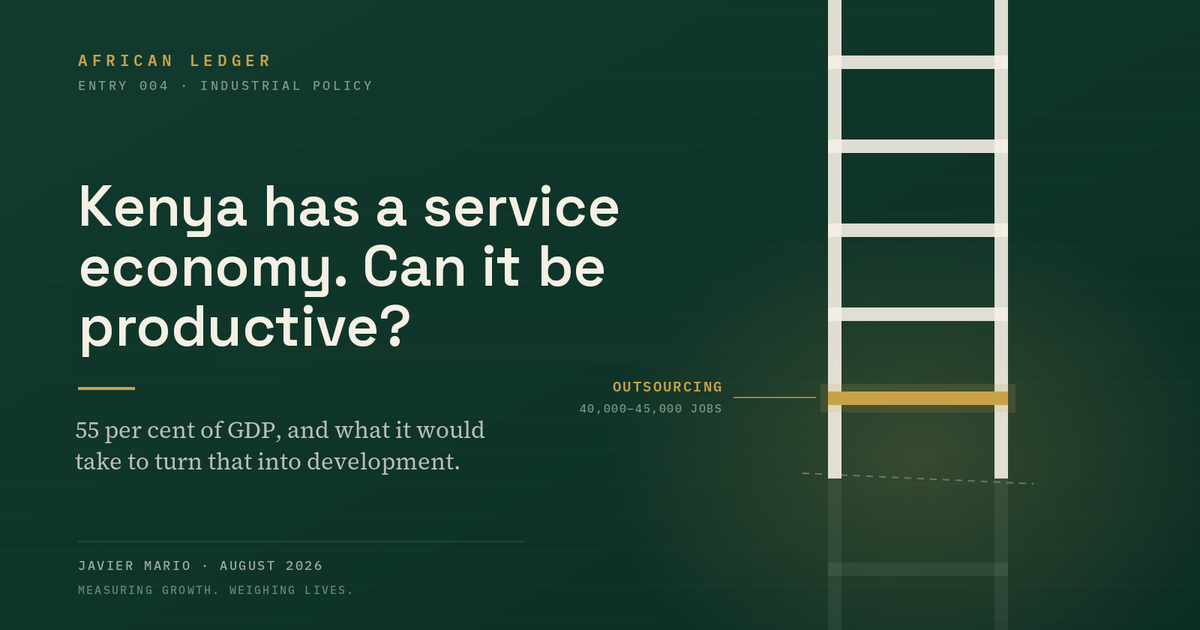

In April 2026, Sama told 1,108 of its Nairobi staff that their jobs had ended, after Meta declined to renew a contract. A single client walked away, and a workforce went with it.
The scale matters, because this is the work Kenya has spent a decade building its jobs policy around. Public money went into training young people for online work, into digital infrastructure and hubs, and into a policy framework meant to attract the outsourcing firms that would employ them. The wager was that services sold to foreign buyers could employ Kenyans in numbers that mattered.
How services became the answer
For most of the twentieth century the route out of poverty ran through factories. Arthur Lewis set the terms in 1954, describing an economy in which workers whose labour added almost nothing to the family farm could be moved into industry and made productive at once. Nicholas Kaldor later argued that manufacturing held properties no other sector shared: it grew cheaper as it grew larger, it dragged other industries behind it, and it improved through practice. Japan, then Korea and Taiwan, then China turned the theory into a record, moving millions off the land into export factories and watching output per worker climb for decades.
Then it stopped working. Dani Rodrik measured the pattern across countries in 2016, showing that countries now peak in manufacturing employment earlier and poorer than their predecessors did. Machines took over the assembly line, so factories needed capital and skills more than hands, and production split across borders, so a country entering late captured a thin slice of a long process.
The ladder was still standing, but the bottom rungs had been sawn off.
Attention moved to services, at first for want of an alternative. Services expand as a share of every economy as it grows, fastest of all in poor countries, because people leaving the land have to go somewhere. Ejaz Ghani and Stephen O’Connell asked in 2014 whether services could work as a growth escalator in low-income countries, holding that they create jobs earlier in development than manufacturing and show faster productivity growth. The World Bank set the case out in 2021, sorting services by how far they travel, how much skill they demand and how much they gain from scale.
The proposition, reduced to a sentence, is that a country might now grow rich selling services abroad, as it once did selling goods.
Why Kenya
Kenya is a useful place to test it.
It has the base. Services are already 55 per cent of the Kenyan economy, and it holds something most of its neighbours lack, a real export services sector in outsourcing, finance and professional work. It also never industrialised, so nothing has to be surrendered to try, and the question put to services enthusiasts elsewhere, whether the country would do better building factories, has no purchase here.
The wager was deliberate, publicly funded and sustained for nearly a decade, long enough for the results to be measured. And those results have now met a shock, because automation arrived while the strategy was still being rolled out.
Underneath sits the pressure that makes this urgent. Kenya’s labour force grows far faster than its formal economy creates jobs, and its constraints in schooling and public finance are common across the region, so what holds here is likely to hold elsewhere.
What Kenya has to work with
Outside small-scale farming, about 21.6 million Kenyans were working in 2025. Roughly 18.1 million of them were in informal work, and about 3.3 million held a formal wage job. Of the jobs added over the year, some 87 in every hundred were informal.
The services economy Kenya is being urged to build therefore already exists. It is hawking, matatus, repair stalls, food and small trade, and it absorbs very nearly everyone who needs work. What it never does is become more productive, which is why the wages in it have stayed where they are.
Two things limit what can be done about that. The first is schooling. Roughly one in ten Kenyans of university age is enrolled in higher education, and although placements are climbing quickly, the graduates who would staff a large professional services industry are still in secondary school.
The second is money. Public debt stands at around 69.5 per cent of the economy in nominal terms, and the Treasury does not expect it back under the legal anchor of 55 per cent, measured in present value, until 2029. Debt service took roughly seven shillings in every ten of ordinary revenue in the 2024/25 financial year. A treasury in that position cannot fund the training colleges, industrial parks or research that a services strategy demands, which leaves it courting somebody else’s capital.
Set the digital jobs effort against those numbers. Outsourcing employs between forty and forty-five thousand Kenyans, while the economy added around 800,000 jobs in 2025. Ten years of public money aimed at digital work has produced about five per cent of a single year’s job creation, which means even a fully successful version was never going to carry the labour force.
Why factory jobs worked
Factories once absorbed large numbers of low-skilled workers and raised their productivity. Outsourcing has created jobs without reproducing that transformation. The difference lies in the mechanism through which each sector raises productivity.
Consider a Korean shirt factory in 1965. New machines arrive, each worker begins sewing twice as many shirts, and costs fall so prices follow them down. At the lower price, the world wants far more shirts than before, so the factory sells several times the volume and hires more people to keep pace. Output per worker rose, and the workforce grew with it.
Now suppose buyers only ever want the number of shirts they already have. The same machines arrive, the factory sells what it always sold, and it needs half the staff to do so. The improvement is identical, and the result is reversed. What separates the two cases is whether buyers want more once the price comes down. William Baumol described the consequence in 1967. An economy can add jobs without adding productive ones, leaving workers concentrated in services where productivity barely moves.
A rough test falls out of this. Any industry expected to create work on a national scale has to satisfy three conditions together.
It must sell beyond the home market, because a country whose own customers are poor cannot buy its way to full employment.
It must hire people who have not spent years in school, or it will remain small, however good it becomes at what it does.
Its buyers must want more of it as it gets cheaper, or every gain in productivity will cost jobs instead of creating them.
Manufacturing satisfied all three for the better part of a century. Rodrik has spent much of the last decade explaining why services have struggled to repeat it, a case he has since developed with Joseph Stiglitz. Those that sell across borders tend to need skilled people and therefore employ few of them, while those that hire in large numbers are consumed at home and stay capped by what local customers can afford. India makes the point. Service employment there grew out of hotels, shops, salons and local transport, while software and outsourcing between them absorbed a sliver of the workforce.
The rung automation reaches first
Between the skilled tradable services and the local ones sits a third, narrow enough to be usually passed over. Some services sell abroad and still hire people without degrees: call centres, back-office processing, transcription, data labelling, content moderation. For a country with a young, English-speaking, school-leaving workforce and no industrial base, this was the only door standing open and facing outward.
The difficulty is that work travels five thousand miles only when it can be written down exactly, in the form of do this, then this, and flag anything resembling that. It can be supervised from a distance only when the output can be scored against a standard, and it moves at all only when it is digital.
Those are the conditions that made the work outsourceable, and they are the same conditions that make it automatable. Anything that can be written as a rule and marked against an answer key is something a machine can be trained to do.
Caribou Digital, Genesis Analytics and the Mastercard Foundation examined African outsourcing and put at least 40 per cent of tasks within reach of automation by 2030. Customer service makes up nearly half of these jobs and is among the most exposed, and the roles held by women carry the greatest risk. The authors attach a condition: with training in time, workers could move upward instead of out.
Set the machines aside, and the work still fails the third condition. A handful of buyers decide how much labelling they require, and that figure does not climb when the price falls, so a Nairobi firm that doubles its output per worker will sell the same volume and retain half its staff. Sama’s eleven hundred were that arithmetic arriving ahead of schedule.
What is left
Run the three conditions across the Kenyan service economy and the segments separate cleanly. The 18.1 million in informal local services will hire anyone and sell only to Kenyans, which caps them at the level of local incomes. Outsourcing and labelling sell abroad and take school leavers, but their demand is limited and determined by buyers. Software, banking and professional services sell abroad and do expand when they become cheaper, but they need graduates the country has not yet produced. No part of the service economy satisfies all three conditions at once.
There is also a distortion buried in the numbers. Productivity in services is measured in money, as the value of what a worker produces divided by the number of workers, because there is rarely a physical unit to count. In labelling, that value is whatever the buyer agreed to pay. A worker in Nairobi labelling five hundred images an hour and a worker in California labelling five hundred images an hour are doing identical work at identical speed, and they record wildly different productivity. The gap between them is the contract. Some part of what the research calls low productivity in African data work is a record of the price.
Selling to the neighbours
A better-placed market sits next door. Kenyan accountants, insurers, lawyers, engineers, hospitals, colleges and logistics firms already trade across East Africa, and a considerable amount of regional business is run out of Nairobi. Against the three conditions, this performs better than outsourcing does. The market extends well beyond Kenya, so it escapes the ceiling of Kenyan incomes. It wants trained people without demanding only elite graduates. And its advantage rests on proximity, familiarity with the rules and relationships already built, which a machine erodes far more slowly than it erodes a wage difference.
The limits should be stated. About 76 in every hundred Kenyans have electricity and fewer in rural areas, and around 40 per cent are online, so a services economy on that base is a plan for Nairobi and two or three other towns. The AfCFTA Protocol on Trade in Services is the instrument that would open that market in earnest.
What would have to change
For services to carry Kenya, four things would have to move together: a wider set of buyers, so that demand answers price; enough graduates and technicians, which is a project of ten years at least; enough room in the budget to pay for the training and the infrastructure; and a regional market that works in practice. A government spending seven shillings in every ten of ordinary revenue on debt has little left for three of the four.
Kenya spent a decade climbing onto the rung automation reaches first. What does a country do once it is already standing there?