
The trend
Institutions have recently started arguing that African governments need to invest in industry. The African Union published its Green Minerals Strategy in December 2024. It tells governments to build "home-grown incentives" and says these can include subsidies and tax breaks. It points to the United States Inflation Reduction Act and to Chinese purchase guarantees as examples worth copying. The G20 met in Johannesburg in November 2025 and endorsed processing minerals in the country where they are mined. However, none of this says what this would look like.
The previous brief asked whether African states could reach the same goal, while still complying with their trade commitments, by banning exports of raw minerals. The answer was no. An export ban is a quantitative restriction, and both the AfCFTA and the GATT prohibit those. The exceptions written into both treaties do not cover it.
If states cannot close the border, the remaining route is money. This brief asks what rules govern that funding. Almost none exist.
What a subsidy is, and what rules normally do about it
A subsidy is help a government gives to a business. It can be cash. It can be a tax break, a cheap loan, free land, or a promise to buy the output.
Subsidies are not forbidden. Every country uses them. They are regulated because help given in one country changes prices in another. A subsidised Kenyan cement plant sells cheaper cement in Uganda. The Ugandan plant loses sales it would otherwise have made.
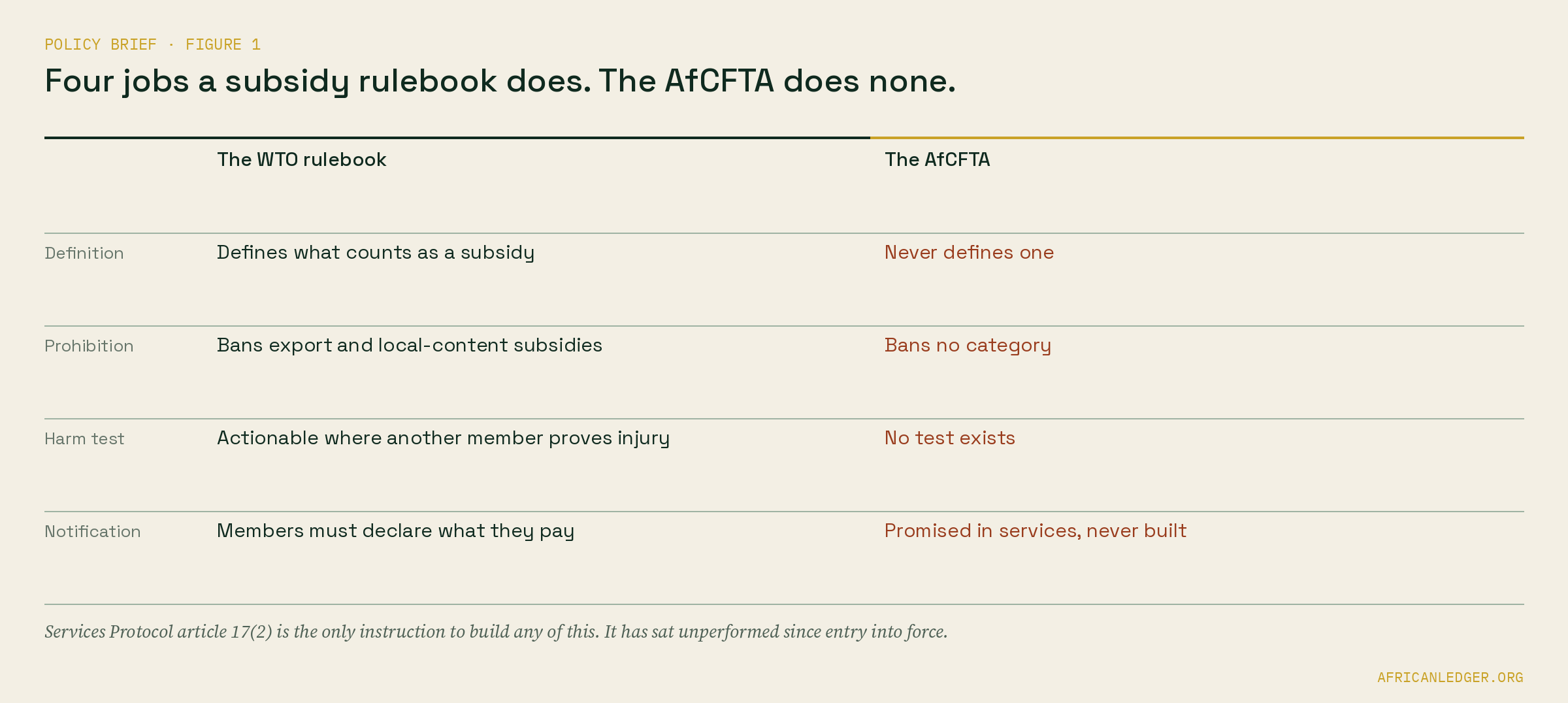
A rulebook on subsidies normally does four things.
First, it defines what counts as a subsidy. Without a definition, there is nothing to argue about.
Second, it bans the worst kinds outright. The usual two are money paid only if a company exports, and money paid only if a company buys local inputs instead of imported ones.
Third, it sets a test for everything else. Other subsidies are allowed unless another country can prove they caused real harm.
Fourth, it makes each government tell the others what it is paying. This is called notification. It is what makes the first three usable. A rule nobody can see is a rule nobody can enforce.
The WTO Agreement on Subsidies and Countervailing Measures does all four. The question is whether the AfCFTA does any.
Two article seventeens
The AfCFTA has an article called "Subsidies." It also has an article that deals with subsidies. They are two different articles, in two different protocols, and both are numbered 17, coincidentally.
Start with the one that carries the name.
Services Protocol article 17 is titled "Subsidies." It has three paragraphs. None of them restricts anything. Paragraph 1 says nothing in the Protocol prevents states from using subsidies "in relation to their development programmes." That is a permission. Paragraph 2 says states "shall decide on mechanisms for information exchange and review." That is a promise to build something later. It has not been built. Paragraph 3 says a state harmed by another state's subsidy may ask for consultations, and the request shall be given "sympathetic consideration." Nothing follows if the consultations lead nowhere.
Now the other one.
Goods Protocol article 17 sits in Part V of that Protocol, headed Trade Remedies. It is titled "Anti-dumping and Countervailing Measures." It says that nothing in the Protocol prevents states from applying those measures.
That is also a permission. The first article lets a state give a subsidy. The second lets a state hit back at somebody else's subsidy. Neither tells the state handing out the money that it must do anything.
Now hold this against the four jobs stated earlier.
The AfCFTA never defines a subsidy. It bans no category. It sets no test for when a subsidy causes enough harm to be challenged. It makes no government declare what it pays, except in services, where the duty was postponed and never written.
The one thing the AfCFTA does have
The Agreement does contain a remedy. Goods Protocol article 17 permits a countervailing duty, which is the standard answer to a foreign subsidy.
Here is how one works. Suppose Kenya subsidises cement. Ugandan cement makers lose sales. Uganda investigates, works out what the Kenyan subsidy is worth per bag, and charges an extra tax on Kenyan cement at the Ugandan border equal to that amount. The extra tax cancels out the help.
Three things follow.
It is aimed at the wrong state. A countervailing duty is something the injured country does. It puts no obligation on the country handing out the money. Kenya need not stop, explain itself, or reply. This is a remedy really and not a discipline.
It cannot be used in most African States. To charge a countervailing duty, a country needs a domestic industry willing to complain, an investigating authority to run the inquiry, and enough officials to finish it. Most AfCFTA states have none of the three. Across 46 disputes brought under the WTO subsidies agreement up to 2022, no African state appeared, either as the country complaining or as the country complained about.
Its rules were never written. Goods Protocol articles 17(2), 18, 19(2) and 20 all direct states to Annex 9 and to a document called the AfCFTA Guidelines on Implementation of Trade Remedies. Those Guidelines have not been adopted. Every provision in the chapter points at a text that does not exist.
Why a countervailing duty is the wrong tool here anyway
Assume the Guidelines appeared tomorrow and every state built an investigating authority. The instrument would still be a poor fit.
Return to the cement example. When Uganda charges the extra tax, who actually pays it? The Ugandan importer does. That importer may be a Ugandan builder or a Ugandan factory using cement as an input. The duty raises their costs.
The AfCFTA exists to build supply chains that cross borders. In such a chain, the buyer of a cheap input is often the business the continent is trying to grow. A countervailing duty taxes that business.
The tool assumes two economies trading at arm's length and seeking advantage over each other. The AfCFTA assumes the opposite.
The WTO is more generous than the AfCFTA
Something surprising follows. On subsidies, the global rulebook gives African states more room than the continental one.
The WTO bans money paid to a company only when it exports. But Annex VII of the subsidies agreement lifts that ban for two groups.
The first group is every least developed country recognised as such by the United Nations, for as long as it stays on that list. Most African WTO members are on it.
The second group is a list of named countries. They stay exempt until income per person passes a set level. Ten of them are African. They are Cameroon, Congo, Côte d'Ivoire, Egypt, Ghana, Kenya, Morocco, Nigeria, Senegal and Zimbabwe.
There is more. Article 27.9 says that where a developing country gives an ordinary subsidy, another WTO member cannot bring a case unless it proves real harm.
So most African states may lawfully pay their exporters today. Few appear to.
Meanwhile, Zambia's mining local content regulations took effect in January 2026. They give local suppliers a 15 per cent price advantage when mining companies award contracts. A benefit conditioned on buying local instead of imported goods is one of the two categories the WTO bans outright. The grace period ran out in 2000 for developing countries and in 2003 for least developed ones.
However, two warnings belong here.
Annex VII protects a state from being taken to Geneva. It does not protect its exports from countervailing duties charged by the United States or the European Union. Those duties are dropped only where the subsidy is worth less than 2 per cent of the product's value. AGOA, which governs African duty-free access to the American market, expires on 31 December 2026. The United States has said that reducing African trade barriers is part of what it wants in return for renewing it.
The exemption also ends abruptly. In India – Export Related Measures, a WTO panel held that a country leaving the Annex VII list gets no transition period. The general grace period expired in 2003 for everyone. A state that crosses the income line loses the entitlement the same day.
Three documents nobody has written
Each gap already has a home named in the treaty.
Services Protocol article 17(2). This is the only place in the whole Agreement that instructs states to build anything to do with subsidies. It has never been done. Notification is the simplest form of discipline and the cheapest item on this list. A government that must publish what it pays will think harder about paying it.
The AfCFTA Guidelines on Implementation of Trade Remedies. The Guidelines have been referenced several times in the Goods protocol, yet it does not exist to date.
The article 24(2) guidelines. Article 24 lets a state protect an infant industry and requires that the protection last "for a specified period of time." It is the only place in the Agreement where support must carry an end date.
What should happen
Now. A state creating an incentive should write the end date into the law that creates it, together with the results the recipient must show. This needs nobody's permission and costs nothing. The continental level is not providing it.
Standing. The Council of Ministers should carry out the instruction in Services Protocol article 17(2), starting with notification.
Article 15 lets the Council waive a state's obligations. When it does, the decision must say why the waiver was granted, must set out the conditions attached to it, and must carry a date on which it ends. Any waiver lasting more than a year must be reviewed every year. The review asks whether the reasons still hold and whether the conditions were met. The Council can then change it or cancel it.
That is a complete subsidy discipline. It requires justification, conditions, an end date, annual review, and the power to withdraw the measure. The continent already adopted these safeguards for waivers.
Not recommended. Copying the WTO's full test for measuring harm. That test needs investigators and economists. The trade remedies chapter has already shown they are not there. Importing it would produce a second unused rulebook.
The catch
Every government wants to keep its own options open. A rule limiting subsidies would limit its own. That is perhaps why the instruction in article 17(2) has sat unperformed since the Protocol took effect.
That explanation does not cover everything. When the East African Community filed its joint schedule of services commitments, Tanzania wrote in a single line keeping its freedom to subsidise while Burundi, Kenya, Rwanda and Uganda did not. Kenya and Uganda instead wrote in rules requiring foreign suppliers to buy local, and Uganda added a duty to transfer technology and train nationals.
Those four states could still require companies to build capability, but they could no longer finance it. Their fifth partner retained both powers under the same agreement.
A rule survives only when someone has an interest in enforcing it. At present, no group within an African country is made worse off when a neighbouring government grants subsidies. Until that changes, Article 17(2) is likely to remain unused.
If African states do not write these rules, the rules will arrive from elsewhere. They will come as conditions on AGOA renewal, as carbon rules at the European border, and as countervailing duty findings in Washington and Brussels. Those authors have little stake in whether an African industry is ever built.
The question really should not be whether Africa is allowed to pay for its own industrialisation but rather whether the region can agree on how it should be done.