
The trend
African states are increasingly legislating to keep more of what they extract. Local content rules have spread across mining legislation over the past 15 years and export bans are the newer, harder instrument. Global export restrictions on critical raw materials now stand at roughly five times their 2009 level, and the latest wave is disproportionately affecting Africa.
While the objective is sound, the instruments chosen deserve closer scrutiny. As the AfCFTA enters its formative years, one of its earliest legal tests may well be the growing use of export restrictions on unprocessed minerals by African states.
| Instrument | Examples | A quantitative restriction? |
| Export ban | Zimbabwe, all unprocessed minerals, Feb 2026; Namibia, unprocessed lithium, cobalt, manganese, graphite, rare earths, Jun 2023 | Yes; Protocol on Trade in Goods art 9; GATT art XI:1 |
| Export quota | DR Congo, cobalt, ARECOMS system from Oct 2025 | Yes; Protocol on Trade in Goods art 9; GATT art XI:1 |
| Local content | Zambia, Kenya, Burkina Faso | Plausibly. A minimum local sourcing rule falls under GATT art III:4 (TRIMs Annex, Illustrative List para 1(a)); a cap on imported inputs falls under art XI:1 (para 2(a)) |
| State purchasing | Ghana, Gold Board Act 2025 | Arguably. State trading under art 25 and GATT art XVII, but a restriction run through a state trader can still engage art 9 |
What they are for
The policy objective is well established. The Africa Mining Vision articulated it in 2009, the African Green Minerals Strategy reaffirmed it in 2025, and the G20 subsequently endorsed beneficiation at source. The concern specifically is the institutional design through which it is pursued.
In this respect, the Green Minerals Strategy reveals a notable omission. While it repeatedly emphasises value addition, beneficiation, and local content, it is silent on sunset clauses and refers to benchmarking only once. It identifies the basis for state support but offers little guidance on the conditions under which that support should be withdrawn.
Why this brief reads the AfCFTA through WTO law
Much of what follows relies on GATT provisions and WTO panel reports for the following reasons.
The Goods Protocol was drafted from WTO models and says so. Article 9 names Article XI of GATT 1994 in its own text. Article 26 reproduces GATT Article XX almost word for word, subparagraphs (g) and (i) included. Where a treaty copies another treaty's language, the case law on the original bears on the copy.
There is also nothing else to read. The AfCFTA Dispute Settlement Body has decided no cases. Until it does, WTO law is the only interpretive resource available for provisions taken from it. Additionally, almost every AfCFTA state is also a WTO member except nine. So, a single export ban has to pass two sets of rules, the AfCFTA and WTO law.
Is it lawful?
No. The Goods Protocol article 9 says:
"The State Parties shall not impose quantitative restrictions on imports from or exports to other State Parties except as otherwise provided for in this Protocol, its Annexes and Article XI of GATT 1994 and other relevant WTO Agreements."
Exports are covered expressly. The case law on Article XI is settled, and it is broad. In Japan — Trade in Semi-conductors the panel held Article XI:1 covers "all measures... prohibiting or restricting the importation, exportation or sale for export," and that it makes no difference whether the measure is legally binding. Export quotas failed in China — Raw Materials and China — Rare Earths. An outright ban failed in Indonesia — Raw Materials, along with Indonesia's domestic processing requirement. So, a measure need not sit at the border to be caught.
The exceptions do not help. Article 26(g) covers conservation, but only where a measure works "in conjunction with restrictions on domestic production or consumption." A ban that expands domestic processing does the opposite. That is how China lost Rare Earths.
Article 26(i) is the exception written for domestic processing industries, and it fails twice. It applies only where domestic prices are "held below the world price as part of a governmental stabilisation plan." No African measure has such a plan, so it never gets started. And if it did, the proviso would end it:
"provided that such restrictions shall not operate to increase the exports of or the protection afforded to such domestic industry."
The one exception drafted for domestic processing forbids using it to protect domestic processing.
But these are infant-industry measures
An export ban is protection. It stops the miner selling abroad, so the ore reaches the local smelter cheaply. Economists call this effective protection, and it is the oldest move in industrial policy. That matters because the Goods Protocol permits infant-industry protection under Article 24. If these bans are infant-industry protection, the treaty may allow them if they are done properly.
However, infant-industry protection usually means tariffs and import quotas, keeping foreign goods out while a young industry finds its feet. An export ban works the other way round.
Article 24 is broadly worded. It authorises "measures for protecting" an infant industry without limiting them to imports or exports. By contrast, Articles 9 and 10 expressly identify the direction of the measure. Article 24 does not, suggesting that the omission was intentional.
Does this allow a state to avoid Article 9 simply by invoking Article 24? No. Article 24 is conditional. It requires that:
- the industry be of strategic national importance
- the state has taken reasonable steps to overcome the difficulties
- the measures are applied without discrimination
- the protection lasts for a specified period.
The current measures fall short. Zimbabwe's ban has no end date. Namibia's does not either, and its system of ministerial approvals raises concerns about equal treatment. The DRC's quota has an end date but retains a discretionary allocation. Without those conditions, they cannot rely on Article 24 and fall back under Article 9.
What about the WTO?
The AfCFTA cannot fix WTO exposure. A waiver from the Council of Ministers cures a breach of the Goods Protocol and nothing else. The Council cannot bind third countries. An export ban stays challengeable by any WTO Member.
But Geneva offers no route either. Article XVIII:C allows developing countries to protect infant industries through quantitative restrictions. But its procedure is limited to import measures. Paragraph 14 requires a state to identify the import restriction it proposes to introduce. No WTO member appears to have argued that the provision also covers export restrictions. The GATT follows the same approach throughout. Export restrictions fall under Article XI:1, and there is no equivalent of Article XVIII:C to justify them on development grounds.
This matters for how Article 9 of the AfCFTA should be interpreted. One reading is that its exceptions simply point to other legal bases within the Agreement. The other is that they also require consistency with the GATT. That second reading is difficult to sustain. It would prevent Articles 24 and 26 from authorising measures that the GATT does not permit and would bind nine AfCFTA members that are not WTO members to obligations they never accepted. Article 21 of the Agreement Establishing the AfCFTA also preserves only African trade arrangements. The better reading is that Article 9 refers to the AfCFTA's own exceptions.
Both the AfCFTA and the GATT leave room for export duties, not export bans. Yet African states have reached for the one instrument the law does not clearly support.
As for enforcement, the honest position is uncomfortable. Indonesia lost DS592 and appealed into a non-functioning Appellate Body, and the case stopped there. Only one African member of the thirty-four is in the MPIA, thus could be denied that escape. But a plan resting on the appeal system staying broken is not really a plan. Additionally, it does nothing about the likelier response: a unilateral response or a buyer quietly sourcing elsewhere.
Three routes nobody used
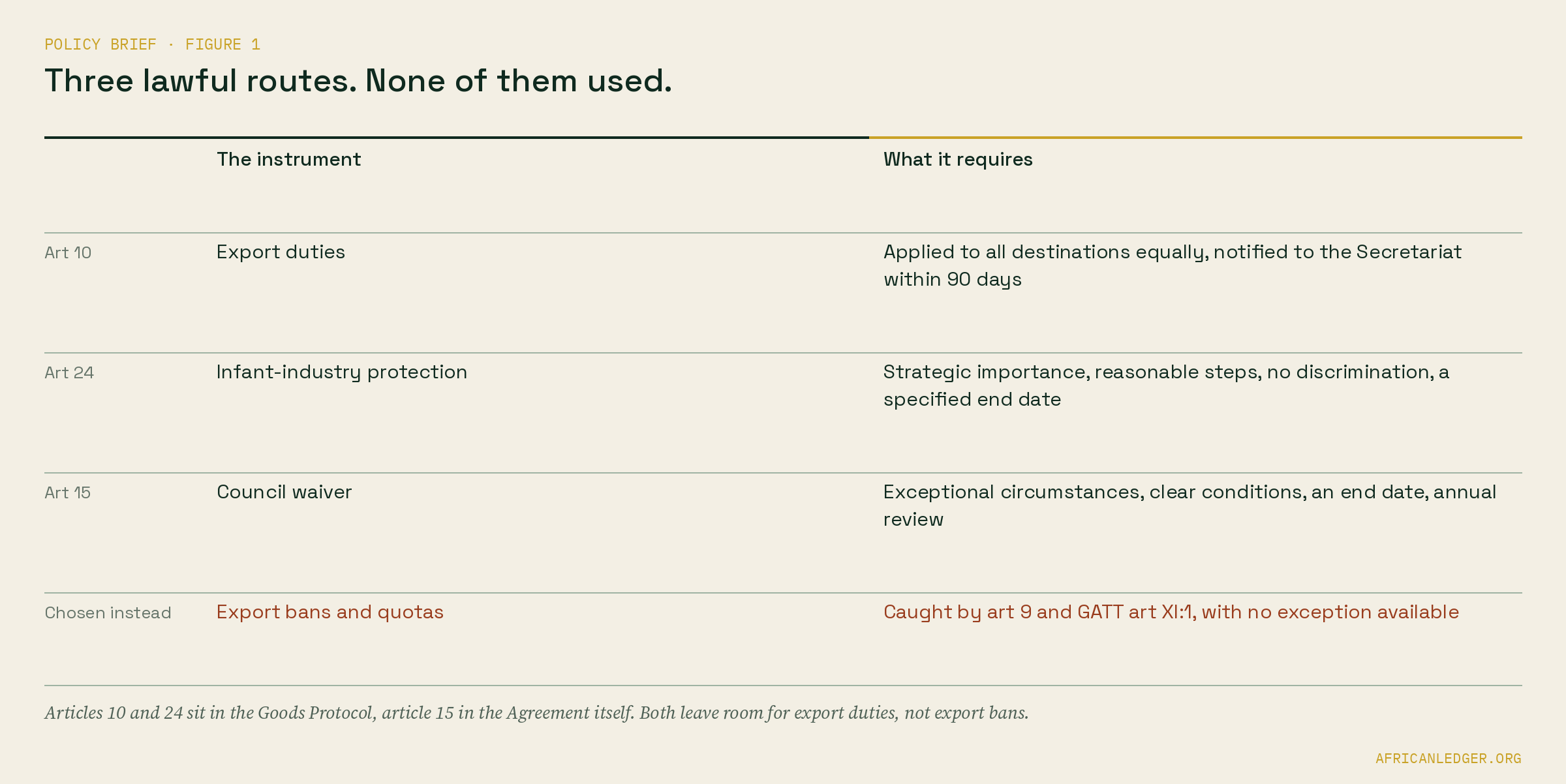
Goods Protocol article 10 leaves export duties nearly unconstrained. A state could apply them to all destinations equally and notify the Secretariat within ninety days. A calibrated export tax does much of a ban's work and raises revenue instead of forgoing it.
Goods Protocol article 24, if the 4 conditions have been met.
Article 15 of the Agreement Establishing the AfCFTA allows the Council of Ministers to waive any obligation owed by a State Party. The waiver must be justified by exceptional circumstances, include clear conditions, have an end date, and be reviewed annually. The Council may also modify or terminate it. Yet there is no indication that Article 15 has been used to support one.
Consensus or a three-quarters majority requires support from states that may bear the costs of the measure. If a policy cannot survive that scrutiny, it may not be one the continent should pursue.
Does it even work?
Legality is only the first problem. A ban can force processing at home, but it cannot ensure that firms build real capability.
Indonesia is frequently cited as a successful example of downstream industrialisation. However, while processing capacity expanded, ownership remained concentrated among foreign firms. Chinese firms hold about three-quarters of refining capacity. The location of production changed, but control over the value chain did not.
Africa's problem is more basic. Smelting needs far more power than mining. Zambia's Copperbelt smelters have been running under power curtailment while the continent debates mandating more smelting. A processing mandate without reliable energy really just creates a bottleneck.
What should happen
Now: States pursuing value retention should ask the Council for an Article 15 waiver instead of legislating alone.
Standing: The Council should adopt the article 24(2) guidelines it has owed since the Protocol took effect. Article 24(2) makes them "an integral part of this Protocol," so they would carry Protocol status and could settle both open questions, that is, whether article 24 reaches export measures, and how article 9's exception clause reads. The guidelines should set a safe harbour. Measures that are notified, justified, benchmarked, non-discriminatory, and time-limited should fall within it.
Nationally: Move discipline from the border to the licence. Licence conditions can be firm-specific, measurable, and withdrawn from firms that fail to perform. They target the producer, not the state's revenue.
But they must be designed carefully. The TRIMs Annex already identifies the risks. Under its Illustrative List, local purchase requirements can violate GATT Article III:4 (paragraph 1(a)), limits on imported inputs can violate Article XI:1 (paragraph 2(a)), and export-related processing requirements may fall within paragraph 2(c) of the same list. A licence condition requiring firms to process a share of their production domestically could therefore face the same problem identified in Indonesia — Raw Materials.
Conditions on employment, training, technical grades and local services fall outside all three, because they do not operate on goods. GATT disciplines protect goods, not workers. A requirement to hire and promote local employees does not treat imported products less favourably than domestic ones or restrict trade across borders.
That does not make such measures risk-free. Local service requirements may fall under GATS rather than GATT, depending on a state's commitments in the relevant sectors. Firm-specific conditions imposed on foreign investors may also trigger investment disputes, particularly where they alter existing licences or conflict with stabilisation clauses.
The catch
Precision requires discretion, and discretion is where capture starts. Firm-by-firm conditions mean firm-by-firm negotiation, and the DRC's discretionary quota tranche shows what that looks like. The case for a continental framework really is that discipline is easier to insulate at the continental level than at the national level.