
The consensus, and where it stops being useful
The settled answer to the question of what drives economic development is incomplete in Africa. On the standard account, growth requires two things: access to foreign technology and good institutions.[1] Open the economy to advanced techniques and imported capital equipment, secure property rights and enforce contracts, and convergence with richer economies should follow. This view is powerful precisely because each half is defensible on its own terms. The problem is the hidden assumption that once you remove the obvious obstacles, an economy already knows how to make the things.
For Africa, the more exacting half of that pairing is institutions because technology does not install itself. Hausmann and Rodrik put the consensus plainly. Development is widely taken to require foreign technology and good governance, with failure attributed either to closure or to corruption.[2] The trouble is that much of the relevant technology is tacit, meaning it cannot be reduced to a blueprint and shipped. It has to be absorbed, adapted, and re-learned in local conditions. Hyundai Heavy Industries began with proven Scottish ship designs, yet the two halves of its first super tanker failed to fit together. In response, it established a 300-person design office to develop its own expertise.[3] Japan’s early modern steel furnaces, imported from Britain and Germany, ran badly until they had been reworked for local ores and fuel.[4]
That difficulty on its own would not require anything of the state. Learning is expensive, but a firm that learns keeps what it learns, and ordinary investment logic covers the rest. The complication is that it does not keep all of it. Trained workers move, competitors observe, and adapted methods spread across an industry, so the firm doing the absorbing captures only part of what its learning creates around it. Hyundai survived years of delays and rejected ships because the Korean government guaranteed foreign financing and created demand by requiring Korea's crude oil to be shipped on Korean-owned vessels. That support was not unconditional. Discipline was built into the same strategy. The shipyard was constructed on a scale that forced it to compete in export markets, while the government licensed rival Korean firms to ensure Hyundai faced domestic competition.[5] Remove that arrangement and the calculation facing the pioneer changes entirely. Technology matters. The binding constraint is the institutional capacity to make the learning worth attempting in the first place, and then to make it productive.
What ‘institutions’ has to mean
If this essay were to stop at “good institutions,” it would collapse back into the same consensus it is seeking to challenge. Institutions must be defined more precisely. They are human-created rules and constraints that shape political, economic, and social interactions, including formal rules such as laws and regulations and informal norms such as customs and expectations.[6] Once we ask what institutions actually do, two functions emerge, and the orthodox debate has focused mostly on the first.
The first job is the one Douglass North made famous. Institutions lower the cost of exchange. Where contracts are unenforceable and property insecure, every transaction carries added cost and risk, so trade stays small, local, and personal. Reliable courts and enforcement let exchange become impersonal and large-scale, and that is what unlocks the gains from trade.[7] This is an important function of institutions, and it forms the foundation of the orthodox institutional account. However, it primarily explains how institutions reduce the costs of existing exchange. It does not explain how institutions enable countries to develop new capabilities, create new industries, and transform their economies.
This second function is largely absent from the orthodox institutional discussion because it addresses a different market failure. Hausmann and Rodrik argue that developing economies face uncertainty over their productive potential. The specific goods a country can competitively produce are not known beforehand but are revealed through experimentation.[8] Discovering that a particular good can be made profitably at home is costly and uncertain. But the moment the discovery is made, it can be copied. The pioneer who proves that cut flowers or garments are viable captures almost none of the value created, because imitators enter at once and compete the returns away. In this case, free entry, normally viewed as a virtue, creates the problem. Rich economies solve this problem by granting patents, that is, giving inventors temporary monopoly rights that reward innovation. The entrepreneur in a poor country who proves a whole industry viable gets nothing of the kind. Market allocation alone cannot solve this problem because the incentives involved in discovering new productive opportunities are structurally misaligned.[9]
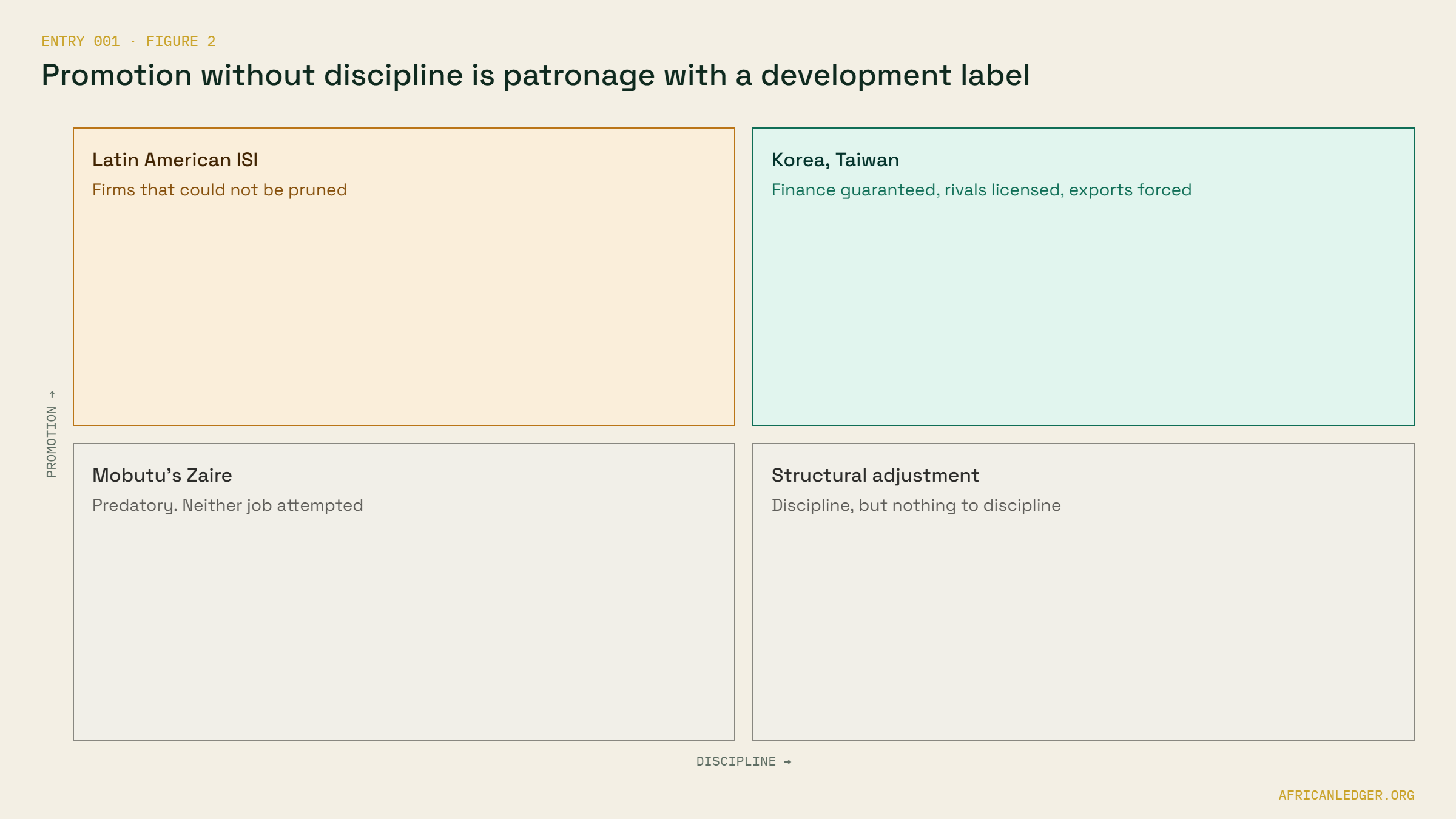
The two failures have the same shape, which is why neither is cured by opening the border or securing property rights. In each case, the firm that bears the cost cannot keep the return, so the economy gets less of the activity than it needs. Closing this gap requires institutions that can support and coordinate the discovery process. Someone has to deliberately reward the pioneer, and someone must withdraw support from the firms that turn out not to be productive. Promotion and discipline both require a durable actor with the authority to pick and to cut off. The divergence between East Asia and Latin America further illustrates this. Korea and Taiwan paired promotion with discipline, cutting off credit and protection to underperformers, while Latin American import substitution supplied plenty of promotion and too little discipline, and produced an industrial structure crowded with low-productivity firms that could not be pruned.[10] Promotion without discipline is patronage with a development label.
So, the orthodox institutional account is half an account. Institutions must do North's job, lowering the cost of existing exchange. But a developing economy needs institutions that do more than make markets work. They must also help create new industries and remove support from those that fail. This is harder because it requires a state strong enough to support firms while remaining independent enough to hold them accountable. That is the demand the rest of this essay is about.
The wrong question, and the right one
Consider Kenya. Its cut-flower industry began with exactly the kind of discovery just described. The costly, uncertain proof that high-value blooms could be grown near the equator and sold profitably in European markets. From the 1990s, the government recognised the sector's economic importance and introduced supportive policies, and it built institutions to regulate and certify exports, to meet Europe's exacting plant-health standards, and to work with the industry in setting the rules the sector needed to compete internationally.[11] Discovery provided the initial opportunity, but institutions supplied the structures and capabilities needed to develop a globally competitive export sector. This is the second job of institutions at work.
Kenya also shows why the question is not whether the state should be ‘in’ the market. This perspective, shaped by the structural-adjustment era, viewed government intervention as inherently harmful. But the successful cases are cases of deep involvement. South Korea directed credit to targeted industries and withdrew support from firms that underperformed. Botswana used a state marketing body to develop, rather than exploit, its cattle industry.[12] This does not reject the orthodox institutional perspective. North correctly argued that institutions reduce transaction costs and provide the reliable enforcement needed for large-scale, impersonal trade.[13] That is necessary, but it is only part of the task. Making existing markets work better is different from building new productive capabilities.
The issue is whether the state can intervene effectively. It must be able to promote new industries, discipline failing firms, and resist capture by private interests. This is a demanding challenge for any state, especially those in Africa.
Embedded autonomy meets the African state
Peter Evans gave the demand its clearest form. Evans argued that a state can drive industrial transformation only if it has embedded autonomy. This means it must be independent enough to pursue long-term goals and resist special interests, while staying closely connected to businesses to understand which industries deserve support.[14] Neither alone suffices. Autonomy without embeddedness is coherent but blind, while embeddedness without autonomy is informed but captured. Evans placed states on a spectrum. At one end were predatory states, such as Mobutu's Zaire, which extracted resources without promoting development.[15] At the other were developmental states, such as South Korea, where state autonomy and close ties with industry supported industrial transformation.[16]
Set against that ideal, the honest name for the default failure mode of the African state is not simply ‘corruption’ but neopatrimonialism. This is a hybrid system where the formal structures of a modern state exist alongside patrimonial practices, with public offices used not to serve society but to maintain personal networks through patronage.[17] Authority runs through the person of the ruler rather than the office, and the resources of the state become instruments of political legitimation. Clientelism, presidentialism, and the use of public resources for private and political ends are its recurring features.[18]
It would be easy, and lazy, to stop there and to treat ‘neopatrimonial Africa’ as an explanation for everything and a prediction of nothing. Mkandawire's warning is essential precisely here. He argues that the concept has been stretched beyond its usefulness. It is often used to explain both failed policies and economic stagnation. Still, when neopatrimonial states succeed, explanations are added after the fact, such as the role of expatriates, isolated reformers, or pockets of integrity that supposedly escaped wider corruption.[19] His criticism is not that patronage is absent, but that the label "neopatrimonial" explains little about why some parts of a state function well while others do not.
And parts of it do work. This is the finding that turns the argument from lament into something more useful. Across African states widely described as neopatrimonial, specific agencies (central banks, revenue authorities, particular ministries) achieve genuine bureaucratic effectiveness, Weberian islands in a patrimonial sea.[20] The ‘pockets of effectiveness’ literature takes these seriously as objects of study rather than explaining them away.[21] But the key lesson is that state capacity alone is not enough. The same efficient institutions can either promote national development or serve elite interests. Angola's oil sector shows how effective institutions can also be used to create and preserve political rents.[22] A pocket of effectiveness is a tool. What it is used for is decided elsewhere, by the configuration of power that Evans called autonomy and that the political-settlements literature calls the balance among a society's most powerful groups.[23]
What follows?
If competence does not guarantee the right outcomes, the solution appears to be rules that constrain state action, such as fiscal laws, constitutional limits, or agency mandates that encourage support for productive firms and discipline failure. But a rule is the weakest anchor in exactly the setting that needs one. A rule binds only if the institutions enforcing it are themselves independent. In a neopatrimonial system, those institutions are part of what has been captured. A law that inconveniences a powerful patron can be amended, ignored, or simply left unenforced. What actually holds a state to discipline is not a rule but an interest. Some domestic actors with real power whose fortunes depend on the discipline holding, and who have reason to fight if it breaks. The strongest form is when the ruler's own power depends on it, which is why revenue authorities and central banks are the most reliable pockets of effectiveness on the continent. A ruler protects them out of need, not virtue, because the revenue and the currency they guard are what fund the patronage network itself.
Botswana shows the pattern at the level of a whole economy. Its Meat Commission developed the cattle industry rather than plundering it because the country's most powerful rural interests, the chiefs and cattle-owners who dominated its politics at independence, had their own wealth tied directly to that institution working honestly.[24] Botswana benefited from diamonds, but resources alone do not explain its success. Diamond-producing countries are common, but what made Botswana rare was the way it managed them. The difference is that in Botswana the rents sat alongside a productive class powerful enough to demand that institutions function and were spread widely enough that capturing them promised little. Angola shows the inverse arrangement. An oil technocracy can be highly competent and wholly captured, because oil rent sustains itself without any productive constituency. Without a domestic group that benefits from productive state action, state capacity has no clear direction. Whether it builds an economy or enables extraction depends less on rules or resources than on whether powerful actors have an interest in maintaining discipline.
This reframes what reform is for. The task is not to import a template of “good institutions” but, in Brian Levy’s phrase, to work with the grain: to build on the power structures that actually exist while constructing the incentives that make discipline hold.[25]
Three commitments follow, offered as levers rather than guarantees. The first principle is selectivity. Instead of trying to reform the entire civil service at once, focus on areas where political interests already align with effective performance. Revenue agencies are often protected because governments depend on revenue, while monetary authorities are valued because economic instability threatens those in power. Reform should begin where incentives already support better outcomes and expand gradually from successful examples rather than from ideal plans.
The second is insulation, and it has to be built on the first rather than on paper. Semi-autonomous agencies sitting outside ordinary civil service structures can pay competitively, recruit on merit, and refuse political appointments, which is why the model recurs across the continent. But the charter granting that independence is a rule like any other, and can be amended by whoever finds it inconvenient. What keeps a revenue authority’s hiring genuinely insulated is not the statute establishing it. It is that someone with power needs the agency to work, and therefore treats interference with it as a cost to themselves. Insulation is worth designing carefully, but it is always downstream of an interest. Where no such interest exists, autonomy lasts exactly as long as nobody senior wants a post filled.
The third commitment is also the most challenging because it involves building a constituency capable of defending and sustaining the agency over time. An island of competence protected by nothing but one leader's favour is fragile, because favour is withdrawable and leaders change. An agency defended by organised private actors (exporters who need a functioning customs service, manufacturers who need reliable power procurement, producers who need an honest standards body) has defenders with their own reasons to resist its capture. This turns Evans’s concept of embeddedness into a survival strategy. More than simply connecting the state to productive actors, it is a way of deliberately creating the anchor that Botswana benefited from through inheritance. Selectivity creates effectiveness, and insulation protects it, but constituency provides the anchor that sustains it. An organised productive class whose interests depend on maintaining discipline is the closest a state can come to deliberately creating the conditions that many states never develop naturally.
A sober note to end on
It is tempting to treat the identification of these mechanisms as equivalent to implementing them. But the challenge lies not only in understanding the conditions of development, but in building the institutional capacity to achieve them. Even the good case has a failure mode built into it. A state can align elite incentives with development, insulate a capable agency, and generate real transformation but still evaporate when the leadership that protected it departs. Levy's own account of Ethiopia under Meles Zenawi describes a genuinely developmental project resting heavily on a single leader's commitment and therefore exposed to the question of what survives him.[26] What was missing was precisely the anchor. A constituency whose own stake in the project would have outlived the man. This is not an argument against the effort. It is precisely why the second and third elements, insulation and constituency, are essential. Without them, effective institutions remain dependent on individual leaders and may collapse when that support disappears.
The different conversation African economic development needs, then, is not louder advocacy for markets or for states. It is a shift in the question itself. The conversation should shift toward what kind of state intervention builds capability that outlasts the people who built it. Measuring growth is the easy part. Weighing whether it will still be standing in a decade, and for whom, is the harder and more necessary one. That is the question this platform exists to keep asking.
[1] Ricardo Hausmann and Dani Rodrik, ‘Economic Development as Self-Discovery’ (NBER Working Paper No 8952, 2002) 1.
[2] ibid 1–3.
[3] Alice H Amsden, Asia’s Next Giant: South Korea and Late Industrialization (Oxford University Press 1989) 278.
[4] Hausmann and Rodrik (n 1) 30–31.
[5] Amsden (n 3) 273, 275–276, 278.
[6] Douglass C North, ‘Institutions’ (1991) 5 Journal of Economic Perspectives 97, 97.
[7] ibid 97–98.
[8] Hausmann and Rodrik (n 1) 24, 25.
[9] ibid 5.
[10] ibid 20, 21.
[11] Steffany Bermudez and Jane Mumbi Ngige, The Kenyan Flower Subsector: A Model of Enhanced Competitiveness Through Mandatory and Voluntary Sustainability Standards (International Institute for Sustainable Development 2024) 2, 3.
[12] Daron Acemoglu and James A Robinson, Why Nations Fail: The Origins of Power, Prosperity and Poverty (Crown 2012) ch 14.
[13] North (n 4) 97, 98.
[14] Peter B Evans, Embedded Autonomy: States and Industrial Transformation (Princeton University Press 1995) 12.
[15] ibid 43-47.
[16] ibid 48-50
[17] Michael Bratton and Nicolas van de Walle, ‘Neopatrimonial Regimes and Political Transitions in Africa’ (1994) 46 World Politics 453, 458.
[18] Michael Bratton and Nicolas van de Walle, Democratic Experiments in Africa: Regime Transitions in Comparative Perspective (Cambridge University Press 1997) 61-63.
[19] Thandika Mkandawire, ‘Neopatrimonialism and the Political Economy of Economic Performance in Africa: Critical Reflections’ (2015) 67 World Politics 563, 595.
[20] Weberian’ refers to Max Weber’s model of modern bureaucracy: an administration run on impersonal rules, with officials recruited and promoted on merit, applying procedures uniformly and treating office as a public trust rather than personal property. See Max Weber, Economy and Society: An Outline of Interpretive Sociology (Guenther Roth and Claus Wittich eds, University of California Press 1978) vol 2, 956–958. It is contrasted here with the patrimonial logic described above, in which authority flows through personal loyalty rather than rule.
[21] Sam Hickey (ed), Pockets of Effectiveness and the Politics of State-Building and Development in Africa (Oxford University Press 2023) 3-5.
[22] Sam Hickey, 'The Politics of State Capacity and Development in Africa: Reframing and Researching "Pockets of Effectiveness"' (ESID Working Paper No 117, Effective States and Inclusive Development Research Centre 2019) 14. See further Ricardo Soares de Oliveira, ‘Business Success, Angola-Style: Postcolonial Politics and the Rise and Rise of Sonangol’ (2007) 45 Journal of Modern African Studies 595.
[23] Tim Kelsall and others, Political Settlements and Development: Theory, Evidence, Implications (Oxford University Press 2022) 19-21.
[24] Acemoglu, Johnson and Robinson, 'An African Success Story: Botswana' (Working Paper, 11 July 2001) 18, 22. See also Abdi Ismail Samatar, An African Miracle: State and Class Leadership and Colonial Legacy in Botswana Development (Heinemann 1999).
[25] Brian Levy, Working with the Grain: Integrating Governance and Growth in Development Strategies (Oxford University Press 2014) 3–4, 21–23.
[26] Levy (n 23) 145-148.