
For more than two decades, the African Growth and Opportunity Act (AGOA) has provided eligible sub-Saharan African countries with preferential access to the United States market. Its underlying promise was that trade could stimulate investment, expand production and support industrial development.
The results are mixed. AGOA has supported export-oriented industries, attracted investment and created employment, particularly in apparel manufacturing. Yet the expansion of exports has not consistently translated into deeper domestic production capabilities, technological upgrading or economic diversification.
Recent developments expose another vulnerability. Although the United States extended AGOA until 31 December 2028 through legislation enacted in September 2026, its administration announced in November 2026 an intention to terminate the trade preference status of Rwanda and South Africa from January 2027.
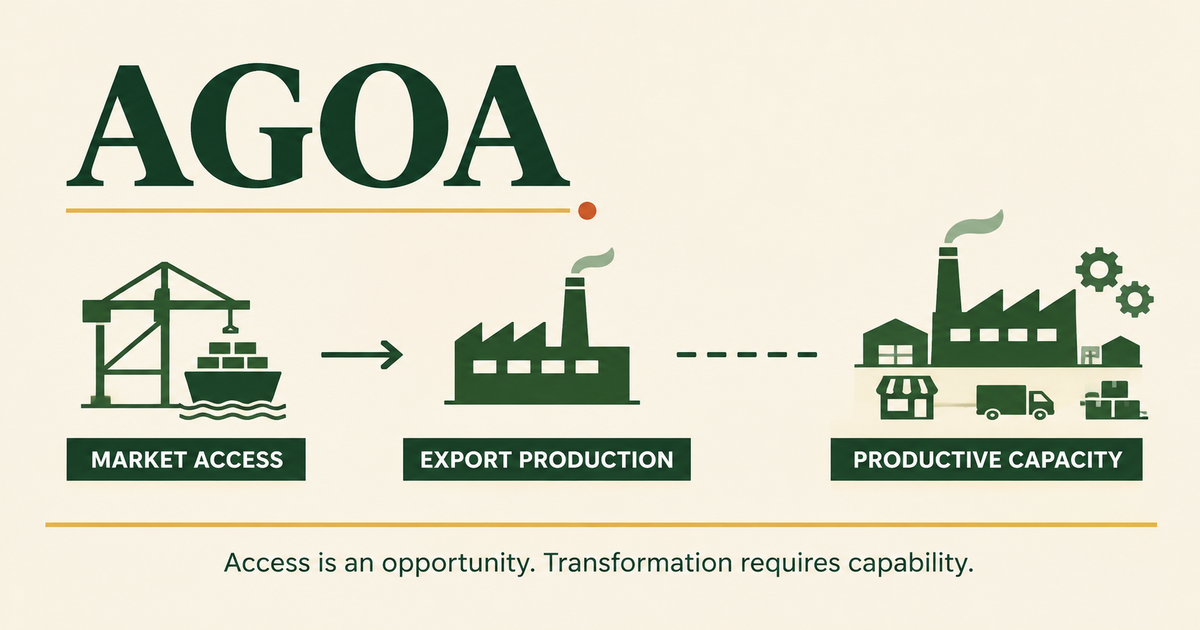
This brief argues that AGOA should be understood as an instrument of industrial opportunity, not an industrial strategy in itself. Its developmental value depends on whether African countries use preferential access to build productive capabilities that can survive the withdrawal of preferences. The challenge is to turn market access into lasting economic capacity.
AGOA?
Enacted in 2000, AGOA provides eligible sub-Saharan African countries with non-reciprocal preferential access to the American market for thousands of products. It was designed to encourage economic development through trade, investment and stronger commercial relationships.
The proposition was straightforward. Preferential access would make African exports more competitive, attract investment into export-oriented industries and create employment. Over time, these activities would contribute to industrial development and economic diversification.
Apparel manufacturing became an important example. Countries with limited textile industries could attract garment manufacturers, participate in global supply chains and create formal employment.
Twenty-six years later, the more important question is whether these opportunities have helped build productive economies. How much value do African countries retain? Have domestic suppliers emerged? Have firms acquired the capabilities to compete without preferential treatment?
What Has AGOA Delivered?
AGOA has supported meaningful commercial activity, although its impact varies across countries and sectors.
In 2024, United States imports under AGOA were approximately US$8 billion, compared with US$9.3 billion in 2023. Crude oil accounted for approximately US$2 billion. Other significant imports included passenger vehicles, apparel, agricultural products, base metals and chemicals.
In 2025, imports claiming duty-free treatment under AGOA fell to approximately US$5.04 billion, a decline of nearly 36 per cent from the previous year. Refined copper became the largest import category, while apparel, passenger vehicles and crude oil recorded substantial declines.
These figures capture imports claiming AGOA preferences, not the entirety of trade between the United States and eligible African countries. Nevertheless, they demonstrate the volatility and concentration of the programme's benefits. AGOA has created employment, attracted investment and introduced African firms to international production standards. However, export growth is not synonymous with structural transformation.
A country may export more garments while importing nearly all the fabric, machinery and specialised inputs required for production. It may generate employment while retaining limited domestic ownership or technological capacity. The distinction is between participating in a value chain and moving up it.
Kenya. Employment Gains and the Limits of Apparel-Led Growth
Kenya illustrates both the benefits and limitations of AGOA. According to the Kenya Export Promotion and Branding Agency, textile and apparel exports reached KSh66.9 billion in 2025, up from KSh60.5 billion in 2024. Employment in the sector exceeded 82,000, reflecting the importance of export-oriented manufacturing to Kenya's formal employment base.
Yet a substantial part of the industry operates through cut-make-trim and assembly activities. These create jobs and generate export revenue but generally capture a smaller share of a garment's final value than textile production, design, branding and distribution.
Assembly manufacturing is a legitimate entry point into industrialisation. The problem arises when entry-level participation becomes a permanent position. Kenya needs to convert apparel manufacturing into a broader textile ecosystem through investment in fabric production, technical skills, machinery and local supplier networks.
The temporary lapse of AGOA preferences in 2025 also exposed the industry's vulnerability. Kenyan exporters reported cancelled orders and production disruptions during the interruption. The lesson is that an industry whose competitiveness depends heavily on a trade preference remains exposed to policy decisions beyond its control.
Rwanda. When Preferences Become Political Leverage
Rwanda offers a different illustration of the relationship between trade preferences and national policy choices.
In 2018, the United States suspended Rwanda's eligibility for AGOA apparel benefits following a dispute over Rwanda's increased tariffs on imported second-hand clothing. The measure formed part of Rwanda's broader effort to restrict used-clothing imports and encourage domestic textile and garment production.
The episode exposed a fundamental tension. Rwanda was pursuing an industrial policy objective, seeking to create space for domestic producers in a market dominated by imported second-hand garments. The United States, meanwhile, treated the resulting trade restriction as grounds for withdrawing a specific preference.
The disagreement illustrates the limits of policy autonomy within a unilateral preference arrangement. A government may pursue a legitimate domestic development objective, yet face commercial consequences when that objective conflicts with the interests or trade policy expectations of its preference-granting partner.
The November 2026 announcement of an intention to terminate Rwanda's AGOA preference status from January 2027 adds another dimension. It should be distinguished from the 2018 apparel suspension. The earlier measure concerned apparel benefits. The latest announcement concerns Rwanda's broader AGOA preference status.
Rwanda's experience raises a question that extends beyond the economic value of its exports. How much room do African countries have to pursue independent industrial policies within trade arrangements whose benefits are subject to unilateral eligibility decisions?
This does not mean that every eligibility condition is illegitimate. Labour standards, governance and market access requirements can serve legitimate objectives. The concern is whether their application is transparent, predictable and consistent enough to support long-term investment. AGOA's value to African countries must therefore be assessed alongside the policy uncertainty embedded in its institutional design.
South Africa. Diversification Does Not Eliminate Sectoral Exposure
South Africa presents a different case.
In 2025, it was the largest AGOA beneficiary, exporting approximately US$1.7 billion under the programme. Its exports included automotive products, citrus and wine. AGOA accounted for approximately 10 per cent of South African exports to the United States, but only around 1 per cent of its total global exports. South Africa is not nationally dependent on AGOA to the same degree that some smaller economies may be. However, particular industries and firms face significant exposure.
Vehicles and vehicle parts constitute an important share of South Africa's AGOA-eligible exports. Losing preferential access could therefore affect established production relationships, investment decisions and employment within a strategically important manufacturing sector.
The United States announced in November 2026 its intention to terminate South Africa's AGOA preference status from January 2027.
South Africa demonstrates that export diversification and market diversification are different things. A country can export a range of products while remaining exposed to policy changes in a particular destination market.
The Structural Problem. Access Is Not Capability
AGOA's central limitation is that preferential market access cannot independently resolve the domestic constraints that prevent African economies from moving into higher-value production. Tariff preferences cannot provide reliable electricity, efficient ports, affordable credit, technical skills or competitive local suppliers. These are the foundations of productive capacity.
The apparel sector illustrates this tension through AGOA's third-country fabric provision. It allows eligible countries to use fabric from outside the region when producing qualifying apparel for export to the United States.
This flexibility has helped African manufacturers participate in global supply chains despite limited domestic textile production. Removing it could make entry into apparel manufacturing considerably more difficult. Yet it also creates a structural trade-off. If manufacturers continue to rely on imported fabric, export growth may not generate equivalent growth in domestic textile production.
The answer is not artificial self-sufficiency. Industrial development often begins with imported inputs, machinery and technology. The objective should be progressive upgrading, enabling domestic and regional firms to acquire skills, improve productivity and enter higher-value activities.
Governments should therefore assess AGOA-supported industries through indicators beyond export earnings. These include domestic value added, local sourcing, productivity, real wages, skills development, technology transfer and the emergence of locally owned suppliers.
AGOA and the AfCFTA. Complementary Instruments
The African Continental Free Trade Area offers an important part of the answer. AGOA provides preferential access to an external market. The AfCFTA seeks to expand intra-African trade and create opportunities for regional value chains. The two instruments perform different but complementary functions.
For example, Kenya's apparel industry could benefit from a stronger regional textile ecosystem. Fabric produced elsewhere in Africa could supply Kenyan manufacturers, while regional markets could provide additional demand. A more integrated regional market could help African firms achieve economies of scale and reduce dependence on suppliers outside the continent.
However, the AfCFTA is not an immediate substitute for AGOA. Regional integration requires progress on infrastructure, customs procedures, rules of origin and the removal of non-tariff barriers. The strategic objective should be to use external market access to strengthen regional productive capacity. African economies should be able to export to the United States while building the industries and supplier networks that make production viable within Africa.
Policy Recommendations
African governments should integrate AGOA opportunities into national industrial strategies. Export promotion must be linked to measurable objectives for domestic value addition, productivity, skills and technological upgrading. Governments should also diversify export markets and invest in the infrastructure and financing that determine industrial competitiveness.
The African Union and AfCFTA institutions should strengthen coordination between national industrial policies and continental trade objectives. They should identify regional value chains capable of supplying both African and external markets.
African businesses should use preferential access to invest in competitiveness, develop local suppliers and improve productivity. Dependence on a single market or tariff arrangement creates unnecessary commercial vulnerability.
Conclusion. A Ladder Must Lead Somewhere
AGOA has provided African countries with valuable opportunities. It has supported export industries, facilitated investment and created employment. Dismissing these gains would be inaccurate. But its record also reveals the limits of trade preferences as an instrument of development. Access to a large market can create opportunities for production. It cannot guarantee technological upgrading, domestic value addition or diversified industrial capacity.
The distinction between a ladder and a leash lies in what happens after access is secured. If African countries use AGOA to develop productive capabilities, deepen regional supply chains and strengthen domestic industries, the programme can serve as a ladder towards structural transformation. If they build industries whose competitiveness depends indefinitely on external preferences, the same arrangement can become a source of vulnerability.
AGOA should therefore be judged by a more demanding standard. The question is not simply how much Africa has exported to the United States. It is what African economies have learned to produce, how much value they retain and whether those gains can survive the withdrawal of preferential treatment. The ultimate measure of a trade agreement's developmental value is what it enables an economy to do after the preference disappears.